Our Short List of 3
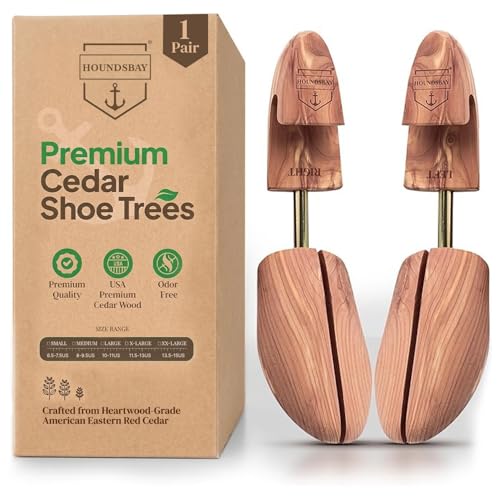
- Best for: One or two pairs of leather dress shoes worn every week.
- Aromatic red cedar grown in the USA
- Split-toe, spring-loaded design
- Brand-disclosed heartwood content above 75 percent
- Right and left engravings on each tree

- Best for: Wide or narrow feet in larger sizes that need one well-fitting pair.
- Combination design with split toe and solid heel
- Adjustable toe for wide or narrow feet
- Brand-disclosed cedar content above 75 percent
- Cedar harvested in Arkansas
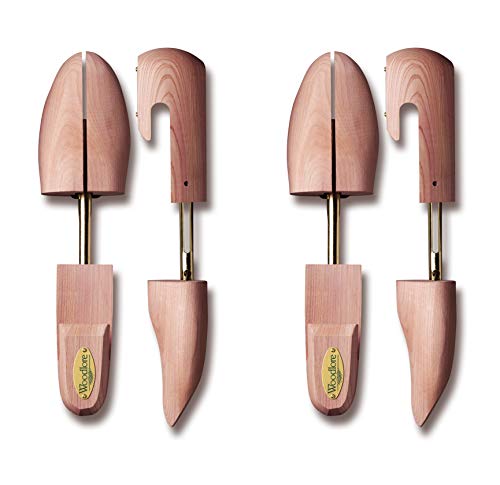
- Best for: A two-pair rotation of women’s leather shoes in smaller sizes.
- Combination design: split toe with solid heel shaft
- Cut specifically to women’s shoe lasts
- Small size band fits US women’s 5 to 7.5
- Red cedar sourced from the Arkansas and Missouri Ozarks
All 4 Picks at a Glance
| Product | Specs | Action |
|---|---|---|
| HOUNDSBAY Cedar Shoe Tree |
| Check price on Amazon |
| Allen Edmonds Men’s Combination Cedar Shoe Tree |
| Check price on Amazon |
| Woodlore Women’s Cedar Wood Shoe Trees, 2 Pairs |
| Check price on Amazon |
 Cobbler’s Choice Men’s Cedar Boot Tree |
| Check price on Amazon |
Key takeaways
- Compare five cedar shoe trees by toe design, size band, and pack count, from an everyday split-toe pair to boot trees and a women's two-pack.
Leather shoes left empty overnight dry unevenly: the vamp creases where it flexed, the heel counter slumps, and the day’s moisture sits in the lining. A cedar shoe tree answers all three problems at once, but only if it actually fills the shoe. Listings differ in toe design, in the width of the size band each size covers, and in how many pairs a box holds, so the real decision is matching a tree’s stated size band and shape to the shoes you already own.
This guide is for anyone keeping a small, deliberate shoe rotation: dress shoes worn daily, boots that live by the door, sneakers in larger sizes, and women’s leather shoes. The five picks below were chosen from their Amazon listing names and stated specifications, spanning split-toe and combination designs, single pairs and two-pair boxes, and size bands from women’s US 5 up to men’s US 14.5.
Quick Picks
As an Amazon Associate we earn from qualifying purchases
| Product | Best for | Key spec from title |
|---|---|---|
| HOUNDSBAY Cedar Shoe Tree | Everyday dress shoes in medium sizes | Split-toe spring-loaded cedar with right and left engravings |
| Allen Edmonds Men’s Combination Cedar Shoe Tree | Wide or narrow feet buying a single pair | Adjustable combination toe with a solid heel |
| Woodlore Women’s Cedar Wood Shoe Trees, 2 Pairs | Women’s leather shoes kept in rotation | Combination trees cut to women’s lasts |
| Cobbler’s Choice Men’s Cedar Boot Tree | Boots that slump at the ankle | Split-toe front with a solid cedar shaft |
| eachway Cedar Shoe Trees | Sneakers and sizes above US 12 | Split-toe cedar sized for US 12.5 to 14.5 |
How to Choose
Match the Size Band, Not the Letter
Every tree here is sold by a letter size, but the letter hides a numeric band, and the bands are narrow. A medium from one brand covers US 8 to 9.5, while another brand’s medium covers 8.5 to 9.5. A tree at the small end of its band barely touches the shoe’s sides and does little work; a tree past the top of its band has to be forced in and can strain the heel. Read the numeric range in the listing, place your shoe size inside it, and prefer a band where your size sits near the middle rather than at either edge.
Split-Toe or Combination Heel
Split-toe trees divide the front into two spring-loaded halves that spread sideways, so they adapt to wider shoes and fill the vamp across its width. Combination trees split only at the front and keep a solid, shaped heel piece that fills the heel cup the way a foot does, which suits narrower dress shoes and anyone who wants the back of the shoe held firmly. Boot trees add a third shape: a split-toe front on a solid shaft that runs up the ankle. Pick the shape that matches the shoe, not the one with the longest feature list.
Read the Cedar Claim Closely
Listings all say aromatic cedar, but the useful detail is how much of the tree is heartwood, the dense inner wood that holds the oils responsible for moisture absorption and scent. A few brands publish a figure, stating heartwood content above 75 percent; most publish nothing checkable at all. An unfinished surface matters too, because varnish seals the wood and blunts absorption. Where a brand discloses a heartwood share and a sourcing region, that claim can be compared across listings. Where it does not, treat the cedar language as decoration and decide on size band and shape instead.
Count Pairs Against Your Rotation
A shoe tree does its work while the shoe rests, ideally from the moment you take the shoes off until you wear them again. That means one pair of trees per pair of shoes in regular rotation, not one pair shared across a whole shelf. Two-pair boxes exist for exactly this reason and usually cost less per pair than two singles. Count the shoes you wear at least weekly, including boots, and buy trees for that number. Shoes worn twice a year can share a single pair of trees moved between them without much loss.
The 5 Best Options
HOUNDSBAY Cedar Shoe Tree
- Best for: One or two pairs of leather dress shoes worn every week.
- Aromatic red cedar grown in the USA
- Split-toe, spring-loaded design
- Brand-disclosed heartwood content above 75 percent
- Right and left engravings on each tree
One or two pairs of leather dress shoes worn every week.
It is sold as a single pair, so a three-shoe rotation needs three boxes; check the numeric band if you wear below US 8 or above US 9.5.
For a single everyday pair, this is the straightforward pick: a spring-loaded split-toe tree in American aromatic red cedar, with the heartwood share actually published rather than implied. The two toe halves spread to fill the vamp, the right and left trees are engraved so the pair stays matched, and the medium band covers the most common men’s dress-shoe sizes. It suits someone with one or two good pairs of leather shoes who wants the strongest cedar claim on this list without buying a multi-pair box.
Allen Edmonds Men’s Combination Cedar Shoe Tree
- Best for: Wide or narrow feet in larger sizes that need one well-fitting pair.
- Combination design with split toe and solid heel
- Adjustable toe for wide or narrow feet
- Brand-disclosed cedar content above 75 percent
- Cedar harvested in Arkansas
Wide or narrow feet in larger sizes that need one well-fitting pair.
This listing is the large size; confirm the size variant on the listing matches your shoes before ordering, since the same tree is sold in other sizes under other listings.
This single-pair tree is built for feet at the edges of standard sizing. The combination design pairs a split, adjustable toe with a solid heel, and the toe is specifically made to adapt to wide or narrow shoes rather than one fixed width. The brand discloses its cedar content, names Arkansas as the harvest source, and handcrafts the trees in Wisconsin. It fits buyers who need exactly one pair, wear a large size, and would rather have an adjustable toe than gamble on a fixed-width split toe in a two-pack.
Woodlore Women’s Cedar Wood Shoe Trees, 2 Pairs
- Best for: A two-pair rotation of women’s leather shoes in smaller sizes.
- Combination design: split toe with solid heel shaft
- Cut specifically to women’s shoe lasts
- Small size band fits US women’s 5 to 7.5
- Red cedar sourced from the Arkansas and Missouri Ozarks
A two-pair rotation of women’s leather shoes in smaller sizes.
The size range is narrow and stops at US 7.5 in this listing; if you wear a larger women’s size, look at the same line’s other size variants rather than forcing this one.
Most cedar trees are cut on men’s lasts and simply labeled unisex, which leaves narrower women’s shoes with a tree that touches at the toe and heel but not along the sides. This Woodlore set is cut to women’s lasts, with the same combination shape, split toe in front and solid heel behind, as the maker’s men’s line, and the same Wisconsin manufacturing and Ozark cedar sourcing. The box holds two pairs, enough for a small rotation of leather flats, loafers, or heels worn through the work week.
Cobbler’s Choice Men’s Cedar Boot Tree
- Best for: Leather boots that fold or crease at the ankle in storage.
- Split-toe front with a solid wood shaft for the boot leg
- All natural aromatic cedar wood
- Brushed brass hardware
- Large size band fits men’s US 10 to 11.5
Leather boots that fold or crease at the ankle in storage.
The shaft is wasted on low shoes, so do not buy it as a general-purpose tree; check that the shaft height suits your boot’s leg before ordering.
A standard shoe tree stops at the ankle, which is exactly where tall boots fail: the shaft folds, creases, and eventually cracks along the fold. This boot tree keeps the split-toe front of a dress-shoe tree and adds a solid cedar shaft that runs up the boot’s leg, holding the ankle upright while the foot section does the usual moisture and crease work. Brushed brass hardware replaces the plain steel spring of budget trees. It is a single-purpose tool, and for households with one or two pairs of boots worn all winter, it replaces the rolled towels and guesswork.
eachway Cedar Shoe Trees
Sneakers and large sizes are where most cedar lines quietly stop: bands end around US 12 and the toe shapes assume a dress shoe. This eachway tree is sized for US 12.5 to 14.5 and is marketed for sneakers and wide dress shoes as much as for oxfords, with a spring-loaded split toe that spreads into a roomy toe box and engraved right and left markings. The brand describes the wood as 100 percent natural aromatic cedar. It gives larger-footed readers, and anyone who rotates canvas or leather sneakers, a cedar option that actually reaches the end of the shoe.
Specs
- Split-toe, spring-loaded design
- Brand-described 100 percent natural aromatic cedar wood
- Right and left engraved markings
- Size L fits US 12.5 to 14.5
- Marketed for sneakers and wide dress shoes
- Sold as 1 pair
Best for: Sneakers and dress shoes in sizes above US 12.
Watch out for: The band starts at US 12.5, so it will not seat properly in smaller shoes; the brand publishes no heartwood share, so the cedar claim is less checkable than the HOUNDSBAY or Allen Edmonds figures.
ASIN: B0FN6YQ2T4
Which One Fits Your Situation
You Wear Leather Dress Shoes Most Days
Start with the HOUNDSBAY pair if your size falls in its medium band: the published heartwood share and the spreading split toe make it the most checkable everyday option here. If you already know one pair will not cover your rotation, the same money buys coverage for two pairs of shoes when you choose a two-pair box instead, and trees only work on the shoes they are sitting in.
Your Shoes Run Wide or Your Size Is Hard to Fit
The Allen Edmonds combination tree adjusts at the toe, which is where wide shoes need room, and its solid heel keeps the back of the shoe honest. For sizes above US 12, skip the adjustable dress trees entirely and take the eachway, whose band starts where the others end. Forcing a too-small tree into a wide shoe gives you neither width nor shape support.
You Keep Boots by the Door All Winter
Give the boots their own trees. The Cobbler’s Choice shaft holds the ankle section upright, which no shoe-length tree can do, and the split-toe front still handles creasing across the vamp. Your low shoes can share the remaining pairs in the closet; boots are the one category where the specialized shape earns its place in a small home.
You Are Outfitting Women’s Shoes or a Shared Closet
Choose the Woodlore women’s set for shoes cut on women’s lasts in the 5 to 7.5 range, since a resized men’s tree leaves gaps along the sides of a narrower shoe. In a shared closet, pair that box with the HOUNDSBAY single for the men’s dress shoes, and label which trees belong to which shoes so the sizes do not migrate.
Common Mistakes
- Buying by the letter size alone without checking the numeric US band printed in the listing.
- Sharing one pair of trees across three pairs of shoes worn in daily rotation.
- Leaving trees in one pair of shoes for a week while the rest of the rotation dries empty.
- Forcing an oversized tree into a smaller shoe to make it fit, which strains the heel counter.
- Assuming the cedar has failed when the scent fades, instead of lightly sanding the surface to refresh it.
Frequently Asked Questions
How long should shoe trees stay in my shoes?
Put them in as soon as you take the shoes off, while the leather is still warm and holding the day’s shape and moisture, and leave them until you wear the pair again. For shoes in weekly rotation that usually means at least a full day of rest. Trees left in permanently do no harm, but trees inserted hours later miss the window when creases set.
Do cedar shoe trees stretch shoes out?
A correctly sized tree should not stretch a shoe; it fills the interior under light spring tension and holds the shape the shoe already has. Stretching happens when the tree is too large for the shoe or when an adjustable toe is spread wider than the shoe’s last. If you have to force a tree in with real pressure, it is the wrong size band, not a snug fit.
Can I use the same trees in sneakers and boots?
Shoe trees work in sneakers if the size band reaches the end of the shoe, and the eachway pick here is made for that. Boots are different: a shoe-length tree supports the foot but leaves the shaft to fold at the ankle, so boots need a boot tree with a shaft section. Using dress-shoe trees in boots is better than nothing, but it does not solve the ankle crease.
How do I refresh the cedar scent?
The oils that carry the scent sit near the surface, so a light sanding with fine sandpaper exposes fresh wood and restores most of the aroma. Wipe the dust off before the trees go back into shoes. Makers of these trees describe this as routine maintenance every year or so. If sanding no longer brings the scent back, the surface is likely sealed or worn, and replacement is reasonable.