Our Short List of 3


All 3 Picks at a Glance
| Product | Specs | Action |
|---|---|---|
 1. Monroe Quick-Strut 172989 — ASIN B07GQ8K6LV | Check price on Amazon | |
| 2. Monroe Quick-Strut 272491, front right for Honda CR-V — ASIN B01MQK8EIT | Check price on Amazon | |
| 3. Monroe Quick-Strut 272492, front left for Honda CR-V — ASIN B01N1GIAGM | Check price on Amazon |
Key takeaways
- A smooth ride comes from fresh, correctly damped struts. Compare Monroe Quick-Strut complete assemblies and learn why the whole unit, not just the damper.
Ride quality rarely disappears in a single event. It leaks away over years as strut dampers lose their charge and their valving wears, until one day the car floats over crests, dives under braking, thumps over expansion joints it once absorbed silently, and keeps bouncing a beat too long after a bump. Owners often blame the tyres or the springs, but on a modern car or crossover the strut is the ride: it is the damper, the spring seat and a structural member of the suspension in one unit, and when its damping fades, no tyre choice restores what was lost. The struts that bring back a smooth ride are the ones that return the suspension to its original damping curve — not firmer sport units, not bargain dampers with vague valving, but assemblies engineered to reproduce the ride the car had when new.
That is precisely the design brief of Monroe’s Quick-Strut line, the complete strut assemblies used as the picks in this guide. A Quick-Strut arrives as a single pre-assembled unit — strut, coil spring, mount, bearing, boot and bump stop already together — built around a damper valved to the original specification of the vehicle it fits. The three listings below were verified against Amazon US listing records during this batch’s research, including their part numbers and applications. Because struts are vehicle-specific, each pick names its fitment plainly; the buying logic — complete assembly, original-specification damping, replaced in axle pairs — is what transfers to every other application in the catalogue.
Why complete assemblies ride better than bare struts
A bare replacement strut reuses your old coil spring, mount and bearing. Those parts age alongside the damper: springs sag unevenly, mounts harden and crack, and the upper bearing develops the notchiness that drivers feel as spring bind and hear as a creak on steering input. Fitting a fresh damper into tired hardware produces a car that is better than before but still short of its original smoothness, and it requires a spring compressor — the one tool in suspension work that genuinely deserves respect — to strip and rebuild each unit.
A complete assembly replaces everything in one bolt-on unit, with the spring already seated and the mount already torqued. The ride benefit is real: new mount rubber isolates road texture the way the factory intended, a fresh bearing lets the spring rotate silently with steering inputs, and the new spring restores ride height, which restores the suspension geometry the alignment was set to. The labour benefit is just as real, because the swap becomes unbolt-and-refit, and the safety benefit of never compressing a coil spring at home should not be underestimated.
Why original-specification damping is the smooth choice
It is tempting to assume firmer means better. For ride comfort the opposite logic holds. The smooth ride a car leaves the factory with comes from damping matched to its spring rates, its weight distribution and its tyre sidewall height. Performance struts deliberately trade that suppleness for body control, and heavy-duty units for trucks and vans are valved for loads a family crossover never carries. Monroe builds the Quick-Strut around its OESpectrum damper technology, which the maker positions as restoring the vehicle’s original ride and handling balance rather than altering it, with application-specific valving — including velocity-proportional damping that stays supple over small, sharp inputs and firms progressively against large ones. That small-input suppleness is exactly where ride quality is judged: the driveway lip, the patched trench, the motorway expansion joint.
Worn dampers fail this test in a recognisable order. First the car needs two or three oscillations to settle after a bump instead of one. Then sharp edges start to crash through because the damper can no longer control the spring’s first movement. Finally the tyres begin to cup and the car wanders in crosswinds, because a wheel that is not held against the road cannot steer or brake consistently. Replacing struts at that stage is not cosmetic; it restores braking stability and tyre life along with comfort.
The picks
1. Monroe Quick-Strut 172989 — ASIN B07GQ8K6LV
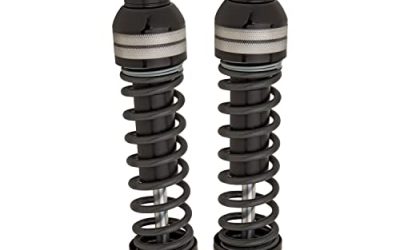
This listing is the Quick-Strut concept in its purest form: a single complete front strut assembly, Monroe part number 172989, sold individually so you order the quantity and side your vehicle needs. Its Amazon listing record confirms the ASIN against the Monroe part number, and the assembly follows the line’s formula — pre-assembled strut, coil spring, mount and bearing, built to restore factory ride height and original-specification damping without a spring compressor. Because Monroe’s catalogue assigns each part number to specific applications and the listing record does not print a year range, the correct way to buy this unit is to confirm your exact vehicle against the listing’s fitment checker or Monroe’s catalogue before ordering; that discipline, not the product name, is what guarantees the assembly on your doorstep matches the suspension on your car.
As the guide’s primary pick it represents the right purchase pattern for a smooth ride: identify the Quick-Strut number for your vehicle, replace both front assemblies as a pair, and have the alignment checked afterwards, because fresh ride height and new mounts change the geometry the old, sagging units had settled into.
2. Monroe Quick-Strut 272491, front right for Honda CR-V — ASIN B01MQK8EIT
The second and third picks show the system applied to one of the most common crossovers on the road. The 272491 is the front right Quick-Strut for the 2007 to 2014 Honda CR-V, verified against multiple Amazon listing records that print this ASIN with its global trade item number and Monroe part number 272491. The CR-V is a useful worked example because its owners report the classic worn-strut symptoms early — a choppy ride on broken pavement and a front end that feels loose over speed bumps — and because its front struts carry the steering axis, so tired upper bearings announce themselves as spring noise on parking manoeuvres.
3. Monroe Quick-Strut 272492, front left for Honda CR-V — ASIN B01N1GIAGM
The 272492 is the matching front left assembly for the same CR-V application, verified the same way, with its own part number and trade item number in the listing records. It is listed separately from its right-hand partner for a practical reason: struts must be replaced in axle pairs to keep damping symmetric. A car with one new strut and one worn strut rides worse in some ways than a car with two equally worn ones — it pitches and rolls unevenly, brakes with a slight asymmetry, and wears its tyres unevenly. The pair of listings exists so you can order both sides in one basket, and that is the only correct way to buy them. Together they renew the CR-V’s front suspension completely: dampers, springs, mounts and bearings, at factory ride height, in a single fitting session per side.
Fitting notes
Strut replacement is well-trodden home mechanic work with complete assemblies, but two points protect the result. First, the mounting fasteners on most applications are torque-critical and some are single-use; follow the vehicle maker’s torque values and replace any bolt the service information calls disposable. Second, book a wheel alignment immediately after. New assemblies restore ride height, and camber and toe set against sagging suspension will be wrong against fresh suspension — the smoothest struts in the world feel nervous through misaligned wheels, and the tyres will record the mistake within a few thousand miles.
Replace in pairs, inspect the sway bar links and lower ball joints while the strut is out since access will never be easier, and expect the ride to feel correct immediately but to settle fully over the first few hundred miles as the new mounts and bushes take their working set.
Frequently asked questions
Does ride height change after fitting Quick-Struts? A complete assembly restores the spring to its designed specification, so a car that had sagged on tired springs will sit at its correct original height afterward — which can look like a lift compared with how it sat before. That is restoration, not modification; the alignment check afterward confirms the geometry is back where the maker intended.
Should struts be replaced in pairs? Yes, across the axle. Fitting one new assembly beside one worn unit gives the axle two different damping rates, which the car reveals under braking and in crosswinds. The left and right part numbers in this guide exist precisely so pairs are fitted together.
How long do replacement struts last? Service life depends on roads, loads and climate, but the honest expectation for quality assemblies is measured in years of normal use, with the damper’s performance fading gradually rather than failing suddenly. The signs in the section above — bounce, dive, cupped tyres, leaks — are the replacement cues whenever they appear.
How do I know my struts are worn? Push down firmly on one corner of the car and release: more than one or two rebounds suggests tired damping. On the road, look for floating over crests, nose dive under braking, cupped tyre wear and thumping over sharp joints. Visible oil weeping down the strut body is a definite failure sign.
Should I buy bare struts or complete assemblies? For a smooth ride, complete assemblies are the stronger choice: they renew the mount, bearing and spring along with the damper, avoid spring compressor work, and restore factory ride height. The Monroe Quick-Strut picks above are all complete assemblies.
Do I have to replace all four at once? Replace in axle pairs at minimum — the two fronts together or the two rears together. If the budget allows and the car is high-mileage, all four restores the original balance completely, because front and rear damping work as a system over every bump.
Will new struts fix a harsh ride caused by low-profile tyres? Only partly. Struts restore damping; they cannot add back sidewall. If the harshness arrived with a wheel and tyre change, the tyres are the cause. If it crept in over years on the original wheels, the struts are the cause.
Is an alignment really necessary afterwards? Yes. Strut replacement disturbs camber and toe, and restored ride height changes them further. An alignment protects both the new ride quality and your tyres.
Verdict
The smoothest-riding replacement strut is the one that gives the car its original suspension back, complete and in pairs. Monroe’s Quick-Strut assemblies do exactly that — pre-assembled units with original-specification damping, fresh mounts, bearings and springs. Start with the Quick-Strut part number for your vehicle, as listed for the 172989 (ASIN B07GQ8K6LV), and if you drive a 2007 to 2014 Honda CR-V, the verified pair is the 272491 front right (ASIN B01MQK8EIT) and 272492 front left (ASIN B01N1GIAGM). Fit them as pairs, align the car, and the ride your car was designed to deliver comes back with them.
Disclosure: As an Amazon Associate, this site may earn from qualifying purchases made through links in this article, at no additional cost to you.