Our Short List of 3

All 4 Picks at a Glance
| Product | Specs | Action |
|---|---|---|
| 1. Panasonic eneloop AA Rechargeable Batteries, 4-Pack (BK-3MCCA4BA) | Check price on Amazon | |
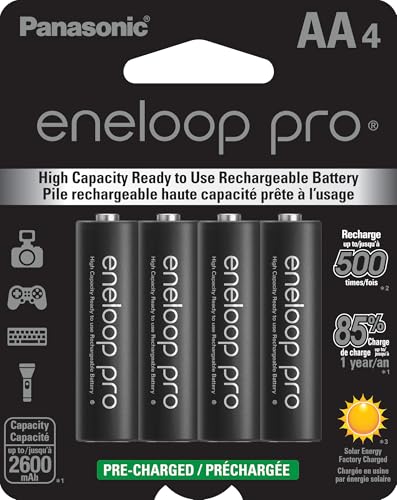
| 2. Panasonic eneloop pro AA Rechargeable Batteries, 4-Pack (BK-3HCCA4BA) | Check price on Amazon | |
 3. Amazon Basics 12-Pack Rechargeable AA NiMH Performance Batteries | Check price on Amazon | |
 4. Amazon Basics 4-Pack Rechargeable AAA NiMH High-Capacity Batteries | Check price on Amazon |
Key takeaways
- The best rechargeable batteries for everyday devices, comparing Panasonic eneloop and eneloop pro AA cells with Amazon Basics AA and AAA NiMH packs on capacity, cycle life, and shelf charge.
As an Amazon Associate we earn from qualifying purchases.
Affiliate Disclosure: This article contains affiliate links. If you buy through a link on this page, we may earn a commission at no extra cost to you. Specifications are taken from the manufacturer’s and retailer’s product pages at the time of writing, and availability can change, so confirm the details on the listing before you order.
What makes a rechargeable battery worth buying
A rechargeable battery earns its place in a drawer by doing three things well: delivering close to its rated capacity in real devices, surviving hundreds of charge cycles without fading badly, and holding its charge on the shelf so it is ready when you pick it up. That third quality is why every pick in this article is a low self-discharge NiMH cell. Older NiMH batteries could lose a large share of their charge within weeks of sitting unused, which made them frustrating for remotes, clocks, and emergency flashlights. Modern low self-discharge designs changed that equation, and the best of them now keep most of their charge for years, not weeks.
This article compares four packs from two proven lines: Panasonic’s eneloop family, which effectively created the low self-discharge category, and Amazon Basics NiMH cells, which aim at the same jobs with a simpler value proposition. All four are genuine rechargeable batteries in standard AA or AAA sizes, all use NiMH chemistry, and all arrive pre-charged and ready to use. None of them is a single-use alkaline dressed up as a rechargeable, and none requires a proprietary charger: any quality NiMH charger, ideally one that charges each cell independently, will handle all of them.
A quick word on voltage, because it confuses many first-time buyers. NiMH cells are rated at 1.2 volts, while fresh alkaline cells start around 1.5 volts. The vast majority of devices — remotes, game controllers, cameras, flashes, toys, wireless mice, flashlights, and microphones — run perfectly well on 1.2-volt rechargeables, and NiMH cells hold their voltage steadier through the discharge cycle than alkalines do. A small number of devices with crude battery gauges may report a partially full reading with NiMH cells even when plenty of runtime remains; that is a gauge quirk, not a power problem.
Quick picks
- Panasonic eneloop AA, 4-pack (BK-3MCCA4BA) — the reference low self-discharge AA, rated for up to 2,100 recharge cycles and long shelf life, best for everyday devices you rely on.
- Panasonic eneloop pro AA, 4-pack (BK-3HCCA4BA) — the high-capacity sibling for power-hungry gear such as camera flashes and game controllers, trading some cycle life for more capacity per charge.
- Amazon Basics AA Performance, 12-pack — a larger, value-oriented AA pack rated at 2,000 mAh and up to 1,000 recharges, suited to households converting many devices at once.
- Amazon Basics AAA High-Capacity, 4-pack — an 850 mAh AAA option for remotes, headlamps, and small electronics, rated for up to 500 recharges.
1. Panasonic eneloop AA Rechargeable Batteries, 4-Pack (BK-3MCCA4BA)
The standard eneloop AA is the battery against which other rechargeable batteries are judged, and its specification sheet explains why. Panasonic rates this cell for up to 2,100 recharge cycles, which is several times the cycle rating of most competitors, and states that the batteries maintain about 70 percent of their charge for up to 10 years in storage under the manufacturer’s test conditions. They arrive pre-charged at the factory in Japan using solar-generated power, and they are rated to perform in temperatures down to minus 4 degrees Fahrenheit, which makes them a sound choice for gear stored in a car, a garage, or a winter emergency kit.
Capacity is the one area where the standard eneloop is deliberately conservative. Panasonic’s own comparison materials rate the standard AA at up to about 2,000 mAh class performance, below the eneloop pro below. That is a design trade, not a flaw: the standard cell exchanges a slice of per-charge capacity for its exceptional cycle count and shelf life. In practice, that makes it the right default for the devices that dominate household battery use — remotes, controllers, wireless mice and keyboards, clocks, and flashlights — where a battery may sit for months between uses and where total lifetime charges matter more than squeezing the longest single run out of one charge.
Build and consistency are the quieter reasons eneloop owners stay loyal. The cells are made in Japan, use Panasonic’s super-lattice alloy to slow self-discharge and stabilize voltage output, and are not discontinued or rebranded season to season, so the pack you buy next year matches the pack you already own. For a household standardizing on one AA rechargeable, that continuity is worth a great deal.
Choose the standard eneloop AA if you want one dependable rechargeable for everyday devices, long storage, and cold-weather kits, and you value lifetime cycle count over maximum capacity.
2. Panasonic eneloop pro AA Rechargeable Batteries, 4-Pack (BK-3HCCA4BA)
The eneloop pro AA is built for the opposite end of the workload: devices that drain a battery hard and fast. Panasonic positions the pro line for high-drain equipment such as tactical flashlights, wireless gaming devices, and camera flash units, and rates the pro AA’s capacity at up to about 2,600 mAh in its comparison materials — meaningfully more per charge than the standard eneloop. For a photographer working an event or a gamer in a long session, that extra capacity is the difference between swapping cells mid-task and finishing on the set you started with.
The trade is explicit in Panasonic’s own figures: the pro cells are rated for up to 500 recharge cycles, a quarter of the standard eneloop’s rating, and they hold about 85 percent of their charge for up to one year rather than matching the standard cell’s decade-long storage claim. Neither figure is a defect; they are the physics of prioritizing capacity. High-capacity NiMH cells work harder per cycle and age faster, which is why mixing roles is the smart household strategy: pro cells in the flash, the controller, and the high-output flashlight; standard cells everywhere else.
Like the standard eneloop, the pro AA is a low self-discharge NiMH cell made to be ready out of the package, and Panasonic rates the pro line for the same low-temperature performance down to minus 4 degrees Fahrenheit. That combination — high capacity plus cold tolerance — also makes eneloop pro a favorite for outdoor gear such as headlamps and GPS units used in winter, where alkaline cells sag badly.
Choose eneloop pro AA if your devices are genuinely high-drain, you recharge frequently anyway, and per-charge runtime matters more to you than total lifetime cycles.
3. Amazon Basics 12-Pack Rechargeable AA NiMH Performance Batteries
The Amazon Basics AA Performance pack answers a different question: what if you want to convert a whole household to rechargeables at once? This is a 12-pack of AA NiMH cells, model HFR-AA2000, rated at 2,000 mAh and for up to 1,000 recharges, and the cells come pre-charged and ready to use. Twelve cells is a practical quantity: it covers a pair of game controllers, a set of remotes, a camera flash pair, and a flashlight, with spares left in the charger — the point at which rechargeables stop being an experiment and start being the house system.
The specifications sit sensibly between the two eneloop lines. Capacity matches the standard eneloop class, and the 1,000-cycle rating, while below the standard eneloop’s headline figure, still represents years of regular use for most devices; a controller recharged weekly would take well over a decade to approach that count. Where the Amazon Basics line makes its case is simplicity and pack economics in qualitative terms: one large pack, one consistent cell type, and no need to assemble a household fleet from several small purchases.
The honest caveats are about ecosystem rather than performance. Amazon Basics cells do not carry the eneloop line’s long published storage-retention claims, so for batteries destined to sit in an emergency kit for years untouched, the standard eneloop remains the safer recommendation. Amazon has also revised its battery line-up over the years, so check that the listing you order matches the Performance specification and model number above rather than assuming every Amazon Basics pack is identical.
Choose the Amazon Basics 12-pack if you are converting many AA devices at once, recharge regularly, and want a single, consistent fleet of cells for the whole home.
4. Amazon Basics 4-Pack Rechargeable AAA NiMH High-Capacity Batteries
AAA devices are easy to forget in a rechargeable conversion, because each one sips power — until a remote, a headlamp, a wireless presenter, and a child’s toy all go flat in the same week. This Amazon Basics AAA pack, model HR-4UTHA-AMZN, is rated at 850 mAh with 1.2-volt output, low self-discharge behavior, and up to 500 recharge cycles, and the cells arrive pre-charged. For an AAA cell, 850 mAh is a healthy high-capacity rating; AAA batteries are physically small, and their capacity figures should never be compared directly with AA numbers.
Low self-discharge matters even more in AAA size than in AA. AAA devices are disproportionately slow-drain, long-shelf-life applications — remotes that live on a coffee table, a headlamp that waits in a drawer for the next trip, a bathroom scale, a laser pointer — exactly the use pattern where a conventional NiMH cell would quietly empty itself between uses. A low self-discharge AAA that is still ready after months in a remote is the entire point of this category, and it is why rechargeable AAA cells have become practical in a way they were not a generation ago.
The 500-cycle rating is the modest figure in this pack’s specification, and it deserves context rather than alarm. A remote control’s AAA cells might be recharged a handful of times a year, so even a few hundred cycles translates into a very long service life in calendar terms. The rating only becomes a real limit in a high-turnover device that is recharged weekly, and few AAA devices work that hard.
Choose this AAA pack if you are extending a rechargeable setup beyond AA devices and want pre-charged, low self-discharge cells sized for remotes, headlamps, and small electronics.
AA, AAA, or something bigger: choosing the right size and chemistry
Buy the size your devices actually take, and resist the adapter shortcut for anything important. C and D adapters that wrap an AA cell exist and can be handy in a pinch, but the device still only gets the AA cell’s capacity, so run times in a large lantern or boombox will be short. Households with genuine C, D, or 9V needs should buy proper rechargeable cells in those sizes from the same low self-discharge NiMH families rather than stretching AA cells into every role.
Within AA and AAA, the real decision is standard versus high-capacity NiMH, and this article’s picks illustrate it cleanly. Standard cells, like the regular eneloop, maximize cycle life and shelf retention. High-capacity cells, like eneloop pro, maximize runtime per charge and age sooner. A two-tier drawer — standard cells for slow devices, pro cells for hungry ones — is the setup experienced users converge on, and it is cheaper in the long run than forcing one cell type to do both jobs badly.
Lithium-ion rechargeables in AA shape also exist, typically with electronics inside that hold output at a steady 1.5 volts. They suit the minority of devices that genuinely misbehave at 1.2 volts, but they need their specified charging method, behave differently on battery gauges, and are a separate category from the NiMH cells compared here. For general household use, low self-discharge NiMH remains the proven, charger-friendly default.
Charging habits that make rechargeables last
Use a smart charger that monitors each cell individually and stops when that cell is full; chargers that charge only in pairs and rely on a timer are the leading cause of cooked, mismatched cells. Keep cells in matched sets for multi-battery devices, label sets with a marker if you own several packs, and do not mix old and new cells or different brands in the same device. Store charged cells in a cool, dry place, recharge stored spares once or twice a year if they guard an emergency kit, and retire any cell that becomes unusually hot while charging, leaks, or loses capacity dramatically compared with its siblings. Never attempt to recharge a single-use alkaline, carbon-zinc, or lithium primary cell; the picks here are rechargeable NiMH and are the only kind of AA or AAA cell that belongs in a NiMH charger.
Frequently asked questions
Can rechargeable batteries really replace alkalines in every device? In almost every household device, yes. The rare exceptions are devices whose makers explicitly require 1.5-volt cells or whose low-battery cut-off is set so high that a 1.2-volt cell triggers it early. Smoke and carbon-monoxide alarms deserve special care: follow the alarm manufacturer’s instructions exactly, and many owners keep long-life primary lithium cells in alarms and rechargeables everywhere else.
How many times can these batteries be recharged? By the manufacturers’ ratings cited above: up to about 2,100 cycles for the standard eneloop AA, up to 500 for eneloop pro AA, up to 1,000 for the Amazon Basics AA Performance cells, and up to 500 for the Amazon Basics AAA pack. Real-world counts depend on charger quality and how deeply the cells are drained.
Do rechargeable batteries save money and waste? Qualitatively, yes, for any device used regularly: a cell recharged hundreds of times replaces hundreds of single-use cells. The benefit is smallest in ultra-low-drain devices where one alkaline lasts years, and largest in controllers, flashes, and toys that eat batteries monthly.
Why does my device show a low battery warning with full NiMH cells? Because many gauges are calibrated for alkaline voltage curves. The device will usually keep running long after the warning appears. Judge NiMH runtime by actual use, not by a gauge designed for a different chemistry.
Verdict
For most households, the standard Panasonic eneloop AA is the foundation pick: unmatched cycle life, decade-scale shelf retention in the manufacturer’s figures, and cold-weather reliability. Add eneloop pro AA for flashes, controllers, and other high-drain gear where runtime per charge rules. The Amazon Basics 12-pack is the practical way to convert a whole home’s AA devices in one step, and its AAA sibling completes the setup for remotes and small electronics. Pick the tier that matches each device’s appetite, charge the cells individually and kindly, and the drawer full of dead alkalines becomes a problem you used to have.