Our Short List of 3

- Best for: Kayakers, canoeists and boaters who want one durable all-round bag.
- Capacity: 20 liters, with sizes from 5 to 55 liters on the same listing
- Material: abrasion-resistant 500D PVC
- Closure: roll-top seal with buckle
- Carry: adjustable shoulder strap, 24 to 42 inches

- Best for: Rafters, tubers and river paddlers whose bag may end up in the water.
- Sizes: 5, 10, 20, 30 and 40 liters
- Material: flexible PVC mesh core, reinforced multi-layer build
- Seams: welded
- Closure: roll-top, rolled 3 to 5 times, with buckle
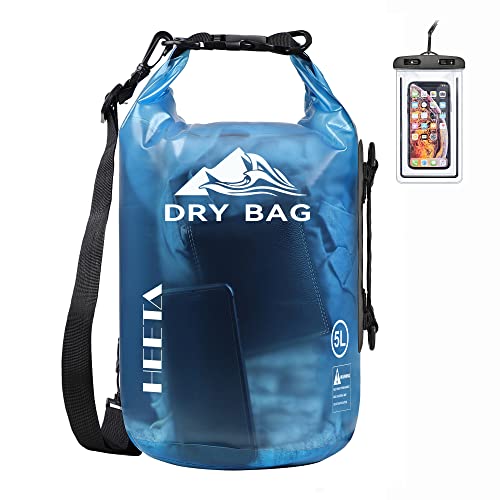
- Best for: Beach, cruise and camping trips where finding items fast matters.
- Sizes: 5, 10, 20, 30 and 40 liters
- Material: PVC, 0.6 millimeter base and 0.3 millimeter sides
- Construction: seamless, fusion-welded seams with double overlap roll top
- Body: transparent, with 11 color options
All 5 Picks at a Glance
| Product | Specs | Action |
|---|---|---|
| Earth Pak Waterproof Dry Bag |
| Check price on Amazon |
| MARCHWAY Floating Waterproof Dry Bag |
| Check price on Amazon |
| HEETA Waterproof Dry Bag |
| Check price on Amazon |
 Sea to Summit Lightweight Dry Bag |
| Check price on Amazon |
 Skog Å Kust DrySak |
| Check price on Amazon |
Key takeaways
- Five roll-top dry bags compared on capacity, material and closure, from heavy PVC boat bags to a light nylon sack that packs inside a backpack.
A dry bag earns its place the first time a kayak takes a wave over the bow or a beach tote tips into wet sand. The real decision is not whether you need one, but which build matches how your gear travels: a stiff PVC sack that lives on a boat deck, a floating bag that stays visible if it slips overboard, or a featherweight nylon sack that disappears inside a backpack. Capacity, fabric weight and the way the top seals separate a bag that shrugs off a dunking from one that only survives drizzle.
This guide serves paddlers, boaters, beachgoers and travelers who pack clothes and electronics anywhere near water. Each pick below is a roll-top dry bag sold on Amazon, chosen from the listing’s stated capacity, material and closure details, and the five span the main buying situations: rough deck use, river trips, see-through packing, ultralight organizing and compact everyday kits.
Quick Picks
As an Amazon Associate we earn from qualifying purchases
| Product | Best for | Key spec from title |
|---|---|---|
| Earth Pak Waterproof Dry Bag | Kayak and boat days with rough handling | Roll-top sack with waterproof phone case |
| MARCHWAY Floating Waterproof Dry Bag | River trips where gear may go overboard | Floating roll-top sack in five sizes |
| HEETA Waterproof Dry Bag | Beach and cruise packing you can see into | Transparent roll-top bag with phone case |
| Sea to Summit Lightweight Dry Bag | Organizing clothes inside a backpack | 13 liter multi-purpose dry storage |
| Skog Å Kust DrySak | Paddle boards and small-boat kits | 10L roll-top waterproof bag |
How to Choose
Capacity and the space the roll takes
Dry bags are sold by volume, but the number on the listing is the unrolled capacity. Rolling the top three or four times to seal it uses up several inches of height, so the usable space is always smaller than the headline figure. As a rough guide, 5 liters swallows a phone, wallet, keys and a snack; 10 liters adds a towel and a layer; 20 liters carries a full change of clothes; and 30 to 40 liters suits a weekend kit or a sleeping bag. If your load sits between sizes, choose the larger bag and roll it down further.
Fabric weight and where the bag rides
Fabric decides where a bag belongs. Heavy 500D PVC, the shell on the Earth Pak and Skog Å Kust picks, is stiff, slick and built to be dragged across gravel, decks and dock edges without tearing. Thinner PVC, like the HEETA’s 0.3 millimeter sides, wipes clean and packs smaller but scuffs sooner. Coated nylon is the opposite trade: the Sea to Summit’s 70D fabric weighs almost nothing and folds into a corner of a backpack, yet it will not survive seasons of deck abrasion. Match the fabric to the roughest surface the bag will meet.
Closure, seams and the buckle
Every pick here seals the same way: fold the stiffened top strip down at least three times and clip the buckle. That fold is the waterproofing, so a bag with a firm strip and a solid buckle seals more reliably than one with a floppy rim. Seams matter just as much. Welded seams, used by MARCHWAY and Skog Å Kust, fuse the fabric into one piece, while the Sea to Summit’s double-stitched, tape-sealed seams keep a sewn bag watertight. Avoid any design that relies on an ordinary zipper as its only barrier against water.
Waterproof claims and submersion limits
Treat headline waterproof claims with care. A roll-top bag is built to defeat rain, spray and a brief dunking, and most makers, MARCHWAY and HEETA included, state plainly that their bags are not made for extended submersion. Ratings need the same care: the IPX8 figure in the Earth Pak listing belongs to the phone case in the box, not the bag, and the Skog Å Kust’s IPX-6 rating covers powerful water jets rather than immersion. If losing the contents would ruin the trip, add a floating design or a second barrier inside the bag.
The 5 Best Options
Earth Pak Waterproof Dry Bag
- Best for: Kayakers, canoeists and boaters who want one durable all-round bag.
- Capacity: 20 liters, with sizes from 5 to 55 liters on the same listing
- Material: abrasion-resistant 500D PVC
- Closure: roll-top seal with buckle
- Carry: adjustable shoulder strap, 24 to 42 inches
Kayakers, canoeists and boaters who want one durable all-round bag.
The IPX8 rating in the listing belongs to the phone case, not the bag itself, so do not treat the sack as submersible.
The Earth Pak is the pick for gear that rides exposed: lashed to a kayak deck, tossed in a boat or set down on wet gravel. Its 500D PVC shell is the heavy, abrasion-resistant class of fabric that shrugs off the scraping lighter sacks cannot, and the 20-liter body takes a change of clothes, a towel and lunch with room to roll the top properly. A single adjustable shoulder strap handles the walk from car to launch, and the included phone case is rated for submersion, so a phone can ride along protected.
MARCHWAY Floating Waterproof Dry Bag
- Best for: Rafters, tubers and river paddlers whose bag may end up in the water.
- Sizes: 5, 10, 20, 30 and 40 liters
- Material: flexible PVC mesh core, reinforced multi-layer build
- Seams: welded
- Closure: roll-top, rolled 3 to 5 times, with buckle
Rafters, tubers and river paddlers whose bag may end up in the water.
It only floats when sealed with air inside and not overloaded; a bag stuffed to the top seals worse and rides low.
The MARCHWAY is built around one idea: if it goes overboard, you should get it back. Its round bottom traps air as you roll the top down, so the sealed bag floats visibly instead of sinking, and the welded seams and flexible PVC mesh core are made for rock scrapes on riverbanks. Five sizes run from a small valuables sack to a 40-liter hauler, with a shoulder strap on the two smallest and backpack straps on the larger three, so the same design covers a tube float and a weekend paddle.
HEETA Waterproof Dry Bag
- Best for: Beach, cruise and camping trips where finding items fast matters.
- Sizes: 5, 10, 20, 30 and 40 liters
- Material: PVC, 0.6 millimeter base and 0.3 millimeter sides
- Construction: seamless, fusion-welded seams with double overlap roll top
- Body: transparent, with 11 color options
Beach, cruise and camping trips where finding items fast matters.
The maker notes it handles accidental submersion but should not be kept underwater, and the clear body shows contents to everyone nearby.
The HEETA suits travelers who pack and repack often, because the transparent body lets you spot a towel, bottle or charger without unrolling the top. The PVC shell uses seamless construction with a thicker 0.6 millimeter base and 0.3 millimeter sides, and the listing spans five sizes from a 5-liter essentials sack to a 40-liter bag with two straps. A touchscreen-compatible phone case comes in the box. Colors run to eleven options, which helps when several people carry the same bag on a group trip or cruise excursion ashore.
Sea to Summit Lightweight Dry Bag
- Best for: Backpackers and travelers organizing gear inside a larger bag.
- Capacity: 13 liters, Olive Green
- Material: PU-coated 70D nylon with DWR finish
- Seams: double stitched and tape sealed
- Closure: Hypalon roll-top strip with field-replaceable buckle
Backpackers and travelers organizing gear inside a larger bag.
Thin nylon is not an abrasion bag for exposed deck use, and the stated capacity assumes the top is rolled three times.
Inside a backpack or duffel, a heavy PVC sack is wasted weight, and that is the job this Sea to Summit does instead. The 13-liter bag is PU-coated 70D nylon with double-stitched, tape-sealed seams, so it keeps rain, condensation and a leaking bottle off clothes and sleeping gear while folding into whatever corner is free. The Hypalon roll-top strip holds its shape fold after fold, the buckle is field-replaceable if it ever breaks, and the white interior makes a headlamp or charger easier to find after dark.
Skog Å Kust DrySak
- Best for: Paddle boarders and small-boat users with a compact day kit.
- Capacity: 10 liters, Waves finish, with 5 and 20 liter sizes in the range
- Material: 500D PVC
- Seams: welded
- Rating: IPX-6 water resistance
Paddle boarders and small-boat users with a compact day kit.
IPX-6 covers strong water jets, not immersion, so clip it to the deck rather than letting it sit in bilge water.
The DrySak is the compact middle ground: a 10-liter roll-top in heavy 500D PVC with welded seams, sized for a paddle board deck, a small boat or a day at the lake. It carries an IPX-6 rating, the clearest waterproof specification among these picks, and the patterned Waves finish is easy to spot among a pile of plain gear. The same design comes in 5 and 20 liters if the kit grows or shrinks. For buyers who want one small bag that can live in the car and come out for any wet day, this is it.
Which One Fits Your Situation
Your bag rides on a kayak deck or boat floor
Choose the Earth Pak 20L if the bag will be dragged across decks, docks and gravel: its 500D PVC shell is built for that abuse, and the shoulder strap covers the carry from the car. If the kit is smaller, the Skog Å Kust DrySak gives you the same class of PVC and welded seams in a 10-liter body that clips easily under deck lines.
You paddle rivers and might swim your gear
Pick the MARCHWAY when the trip involves moving water and a real chance of a capsize or a dropped bag. Sealed with air inside, it floats high enough to spot and grab, and the sizes run from a 5-liter valuables sack to a 40-liter version with backpack straps for the walk back to the car. Leave headroom in the load: an overfilled bag neither seals nor floats as well.
You are packing inside a suitcase or backpack
Take the Sea to Summit Lightweight if the dry bag’s job is organizing the inside of a backpack, duffel or suitcase. The 13-liter nylon sack keeps a set of clothes or a sleeping layer separate and dry for almost no added weight, and the white interior saves digging at night. It is the wrong pick for exposed deck duty, where its thin fabric would wear through.
You need one bag for beach days and cruise excursions
Choose the HEETA for beach bags, cruise excursions and camp kitchens, where the clear body pays off every time you reach for sunscreen or a charger without unrolling the top. The five sizes let one design cover a phone-and-keys kit or a full family beach load, and the included phone case handles the item most likely to meet the water directly.
Common Mistakes
- Rolling the top only once or twice; the seal needs at least three flat folds, with excess air pressed out first.
- Filling a bag to its headline capacity, leaving no fabric to roll and no air space for a floating design to work.
- Treating a roll-top bag as a dive bag; none of these listings promises protection through extended submersion.
- Reading an accessory’s rating as the bag’s rating; the Earth Pak’s IPX8 figure covers the included phone case, not the sack.
- Leaving a sealed bag sitting in bilge water or a hot car for hours, which stresses seams and traps condensation inside.
Frequently Asked Questions
Can a roll-top dry bag be fully submerged?
Brief dunkings are what these bags are built for, not life underwater. A properly rolled and buckled top keeps out rain, spray and a quick capsize, but water pressure finds the fold over time. MARCHWAY and HEETA both say their bags should not stay submerged, so anything that must survive immersion belongs in a rated hard case or a submersion-rated pouch instead.
How many times should I roll the top?
Three folds is the working minimum for most roll-top bags, and MARCHWAY specifies three to five for its floating design. Press the excess air out before the first fold, unless you want the bag to float, in which case trapped air is the point. Each fold should sit flat on the stiffened strip, and the buckle should close without straining against an overfilled load.
What size dry bag do I need for a day trip?
For most day trips, 10 to 20 liters covers it. Ten liters takes a towel, a layer, sunscreen and small valuables; twenty adds a full change of clothes and lunch. Remember that rolling the top consumes space, so a load that exactly fills a 20-liter bag unrolled will not seal. When in doubt, size up and roll the extra fabric down.
Is PVC or nylon better for a dry bag?
They solve different problems. PVC, especially the 500D shells on the Earth Pak and Skog Å Kust, resists abrasion from decks, rocks and gravel and wipes clean, at the cost of weight and bulk. PU-coated nylon like the Sea to Summit’s 70D fabric folds small and weighs very little, which suits life inside a backpack, but it wears faster when dragged across rough surfaces.