Our Short List of 3

- ASIN: B000H7DXBO
- Type: AGM maintenance-free, supplied with acid pack
- Rating: 12V, 18 Ah, 270 CCA
- Size: 175 x 87 x 155 mm (20L case), left-negative polarity layout for L fitments

- ASIN: B09V325VLD
- Type: Sealed AGM, maintenance free
- Rating: 12V, 18 Ah, 310 CCA
- Size: 6.89 x 3.43 x 6.10 in, matching the YTX20HL-BS / YTX20L-BS footprint

- ASIN: B091P96DDB
- Type: Lithium iron phosphate (LiFePO4) with intelligent battery management system
- Rating: 12V class, 7 Ah, 600A starting current
- Fitment: Group 20 case with included spacers and multi-position terminals; replaces YTX20HL-BS, YTX20L-BS, GYZ20HL and many related sizes
All 4 Picks at a Glance
| Product | Specs | Action |
|---|---|---|
| 1. Yuasa YTX20L-BS (YUAM320BS) — The OEM Baseline, Done Right |
| Check price on Amazon |
| 2. UPLUS YTX20HL-BS (EB20H-3) — 310 CCA in the Same Box |
| Check price on Amazon |
| 3. NOCO Lithium NLP20 — 600 Amps of Starting Current |
| Check price on Amazon |
 4. TYKOOL LFP20L-BS-STD — Lithium With a Voltage Display |
| Check price on Amazon |
Key takeaways
- The best battery for a high compression Harley needs real cranking headroom in the correct case size. Compare four AGM and lithium picks by CCA, fitment and polarity.
As an Amazon Associate we earn from qualifying purchases.
A high compression Harley build changes what your battery has to do. Raising compression with big-bore pistons, milled heads or high-lift cams makes each cranking cycle work harder, because the starter motor has to push the pistons through a much stiffer compression stroke. A stock-spec battery that spun a mild 88 or 96 cubic inch engine without complaint can suddenly sound lazy, click through the starter relay, or heat up the starter on a built 103, 110 or larger motor. Add summer heat soaking the oil tank area, short-hop riding that never fully replaces the charge used at startup, and the vibration a big twin produces at idle, and the battery becomes one of the most stressed parts on the bike.
The fix is not simply the biggest battery you can find. Harley battery boxes are sized for specific case groups, and a battery that is a quarter inch too tall or has its terminals on the wrong side simply will not install. The right approach is to stay inside the case size your bike was built for, then maximise cranking output, capacity and build quality within that footprint. For most Softail, Dyna and V-Rod models that means the 20L case family, which is where the four picks below live. Touring models use a larger 30-size case, and Sportsters from many years use a smaller 14L case, so treat this list as a 20L-case guide and confirm your own fitment before ordering anything.
Affiliate Disclosure: This article contains affiliate links. If you buy through a link on this page, we may earn a commission at no extra cost to you. Product specifications are taken from the manufacturers and product listings, and availability can change, so confirm fitment and stock on the product page before you order.
Quick Comparison
| Pick | Type | Output | Capacity | Best for |
|---|---|---|---|---|
| Yuasa YTX20L-BS | AGM, acid pack included | 270 CCA | 18 Ah | Stock-fit replacement from the OEM supplier |
| UPLUS YTX20HL-BS (EB20H-3) | AGM, sealed | 310 CCA | 18 Ah | More cranking amps in the same 20L case |
| NOCO Lithium NLP20 | LiFePO4 lithium | 600A starting current | 7 Ah | Maximum starting punch and low weight |
| TYKOOL LFP20L-BS-STD | LiFePO4 lithium | 480 CCA (maker rated) | 8 Ah | Lithium cranking with a built-in voltage readout |
Why High Compression Engines Kill Ordinary Batteries
On a stock engine, the starter only fights the factory compression ratio. On a built engine, higher static compression, aggressive cam timing that keeps effective compression high at cranking speed, and larger displacement all stack up. The starter draws more current for longer, voltage sags deeper, and a marginal battery that still shows a healthy resting voltage can fall flat the moment you press the start button. This is why a load test and the cold cranking amp figure matter more than a simple voltage reading on a high compression build.
Heat and vibration finish the job. The battery on most big twins sits close to the oil tank and engine, and repeated heat cycles age lead-acid plates faster. Vibration works on plate material and internal connections over time, which is one reason absorbed glass mat (AGM) construction, where the electrolyte is held in fibreglass separators and the plates are packed tightly, suits these bikes better than old-style flooded batteries. If your build does not have compression releases, or they are not wired and working, no battery fully compensates for that. Working compression releases plus a strong battery is the combination that makes a big-inch Harley start like a stocker.
The Picks
1. Yuasa YTX20L-BS (YUAM320BS) — The OEM Baseline, Done Right
- ASIN: B000H7DXBO
- Type: AGM maintenance-free, supplied with acid pack
- Rating: 12V, 18 Ah, 270 CCA
- Size: 175 x 87 x 155 mm (20L case), left-negative polarity layout for L fitments
Yuasa is the original equipment supplier behind the battery most Harleys left the factory with, and the YTX20L-BS is the standard-fit unit for a long list of Softail, Dyna and related models. At 270 CCA it is not the strongest battery on this page, and on a heavily built engine it is best viewed as the dependable baseline rather than the upgrade. Its value is fitment certainty and construction quality: the case dimensions, terminal position and hold-down shape match what the bike was designed around, and Yuasa’s AGM design with lead-calcium plates is built to tolerate big-twin vibration.
This version ships with its acid pack, so you fill it, let it soak and give it a full initial charge before installation. That extra step is worth doing properly, because a bottle-supplied battery that is filled and charged correctly on day one generally outlasts one that is rushed into service half activated. Choose the Yuasa if your engine is stock or mildly built, you want the closest thing to a factory replacement, and you prefer a proven lead-acid unit over newer chemistries. If your build regularly struggles to turn over hot, step up to one of the higher-output options below instead of buying the same specification again.
2. UPLUS YTX20HL-BS (EB20H-3) — 310 CCA in the Same Box
- ASIN: B09V325VLD
- Type: Sealed AGM, maintenance free
- Rating: 12V, 18 Ah, 310 CCA
- Size: 6.89 x 3.43 x 6.10 in, matching the YTX20HL-BS / YTX20L-BS footprint
The HL in YTX20HL-BS stands for the high-cranking version of the 20L case, and that is exactly the upgrade a high compression engine needs. The UPLUS EB20H-3 follows that pattern with a 310 CCA rating in the same 175 x 87 x 155 mm footprint as the standard battery, so it drops into Softail, Dyna and other 20L battery boxes without modifying the tray, cables or hold-down. The listing identifies it as a sealed, maintenance-free AGM compatible with Harley-Davidson models that call for the YTX20HL-BS or YTX20L-BS, along with equivalent designations such as the YUAM320BS pattern.
Forty extra cold cranking amps over the standard specification does not sound dramatic on paper, but cranking a high compression twin is a game of voltage under load. The battery that holds its voltage higher during the first compression stroke is the one that keeps the starter spinning briskly instead of bogging down. The sealed case also removes any need to check electrolyte levels, and the polypropylene case material is chosen for heat resistance around the oil tank area. As with any battery bought by cross-reference, confirm the terminal orientation against your old unit before ordering, because the L designation fixes the polarity layout and a reversed battery will not connect safely.
3. NOCO Lithium NLP20 — 600 Amps of Starting Current
- ASIN: B091P96DDB
- Type: Lithium iron phosphate (LiFePO4) with intelligent battery management system
- Rating: 12V class, 7 Ah, 600A starting current
- Fitment: Group 20 case with included spacers and multi-position terminals; replaces YTX20HL-BS, YTX20L-BS, GYZ20HL and many related sizes
When a built engine needs serious cranking authority, lithium changes the equation. The NOCO NLP20 is rated at 600 amps of starting current, roughly double the cranking output of the lead-acid batteries above, and it delivers that current with far less voltage sag because lithium cells hold their voltage under load. NOCO states the battery replaces a long list of lead-acid sizes including the YTX20HL-BS and GYZ20HL fitments used on many Harleys, and the box includes removable spacers and three-way terminals so the smaller, much lighter lithium unit can be secured in a battery box designed for a heavier lead-acid case.
The built-in battery management system protects against overcharge, short circuit and thermal faults, and the unit is UL certified and backed by a five year limited warranty according to the listing. There are honest trade-offs to plan around. Lithium needs a lithium-compatible charger or maintainer, since some older lead-acid tenders with automatic desulfation pulses are not suitable. Lithium also dislikes cranking in deep cold until the battery warms itself through a brief load, and you should confirm your bike’s charging system is healthy and regulated within normal limits, because a failing regulator is hard on any battery and lithium least of all. For a high compression build that is ridden regularly in mild to warm weather, the NLP20 is the strongest starter on this list.
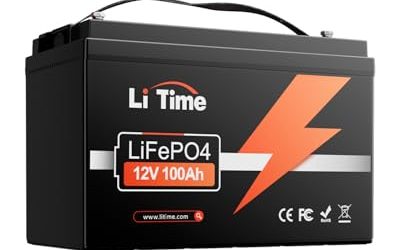
4. TYKOOL LFP20L-BS-STD — Lithium With a Voltage Display
- ASIN: B0DKDVMM24
- Type: Lithium iron phosphate (LiFePO4)
- Rating: 12V, 8 Ah, 480 CCA (maker rated)
- Fitment: Replaces YTX20L-BS and Harley-Davidson part 65989-97C pattern; listing names Softail, Fat Boy, V-Rod and Heritage Classic
The TYKOOL LFP20L-BS-STD is built specifically around the Harley 20L fitment, cross-referencing the factory 65989-97C battery family used across many Softail models. Its maker-rated 480 CCA sits between the AGM options and the NOCO above, which is still a large step up from a stock lead-acid unit, and the listing highlights a digital readout on the battery itself. That display is more useful than it sounds on a high compression bike: a quick glance at resting voltage before a ride tells you whether the battery is ready to crank a stiff engine or needs time on a charger first, without digging out a multimeter.
Like the NOCO, it is a fraction of the weight of the lead-acid battery it replaces, which also makes installation in the tight Softail battery box noticeably easier on your back and fingers. The same lithium ground rules apply: use a lithium-compatible charger, keep the charging system in good health, and expect to follow the maker’s guidance for cold weather starting. If your Softail, Fat Boy or Heritage runs a big-inch or high compression top end and still carries its original-style battery, this is a direct-fit way to gain cranking headroom without changing anything else in the starting system.
Fitment First: Getting the Right Case Size
Every pick above lives in the 20L case family, roughly 175 mm long, 87 mm wide and 155 mm tall, with the L polarity layout. That covers a wide range of Softail and Dyna models and the V-Rod, but Harley has used several battery sizes across its line-up. Touring models generally take the larger 30-size case, many Sportsters take the smaller 14L case, and older models differ again. The reliable checks are the part number printed on your current battery, the battery section of your owner’s manual, and a tape measure across the battery box. Match all three before you order, and match terminal orientation as well as dimensions, because a battery with reversed terminals can stretch cables into unsafe positions or simply refuse to connect.
Also check the rest of the starting system while the seat is off. Corroded or loose ground straps, a tired starter relay and cable ends with green corrosion under the insulation all waste cranking power that a high compression engine cannot spare. Upgrading the battery while leaving a bad ground in place is the most common reason a new battery seems to make no difference.
Buying Guide: What Actually Matters
Cranking output. For a high compression build, treat the factory CCA figure as the floor, not the target. Stepping up within the same case size, from 270 CCA to 310 CCA in AGM or to a lithium unit with several hundred amps of starting current, is the single most effective change you can make.
Capacity. Amp-hour capacity is about reserve: running lights and accessories with the engine off, repeated start attempts, and how the battery tolerates sitting between rides. AGM picks here carry 18 Ah. Lithium batteries list lower amp-hour figures but deliver their cranking current more effectively; judge them on starting performance and your riding pattern rather than the raw number alone.
Chemistry. AGM is the proven, tolerant default and works with standard chargers and every Harley charging system in good order. Lithium gives far stronger cranking and much lower weight, at the cost of needing a compatible charger and a healthy regulator. Either is a sound choice; a neglected charging system ruins both.
Charging habits. High compression engines take more out of the battery at every start, so a quality maintainer between rides genuinely extends battery life. Connect it after rides if the bike sits for days, and fully charge any new bottle-supplied AGM before its first start.
Compression releases and starter health. If your build has manual or automatic compression releases, confirm they work. A battery cannot outmuscle a disabled release for long, and chronic slow cranking overheats starters. Treat battery, releases, cables and starter as one system.
Frequently Asked Questions
How many CCA does a high compression Harley need?
Start from the figure specified for your model, then go up within the same case size. Many 20L-case bikes ship with batteries in the 270 CCA range; a 310 CCA AGM or a lithium battery rated for several hundred amps of starting current gives a built engine useful headroom without any fitment changes.
Can I use a lithium battery in an older Harley?
Generally yes, provided the charging system is healthy and regulates voltage correctly, and you use a lithium-compatible charger for maintenance. Check the battery maker’s stated voltage limits against your regulator’s behaviour if the bike is older or the charging system has been modified.
Why does my bike start fine cold but struggle hot?
Heat raises the effort needed to crank a high compression engine while a heat-soaked battery and starter are at their weakest, and marginal cables make it worse. A higher-output battery helps, but also inspect cable condition, grounds and compression releases before blaming the battery alone.
Will a bigger-case battery fit if I remove the padding?
Do not force an oversize case into the box. A battery that is wedged in can chafe, crack or short against the frame, and terminal clearance matters as much as the footprint. Stay with the case size your model specifies and gain performance within it, as the picks above do.
How long should a Harley battery last?
Service life depends on heat, vibration, charging habits and how deeply each start discharges it. Keeping the battery on a suitable maintainer, fixing charging faults early and avoiding repeated deep cranking sessions are the habits that most extend its life, whichever chemistry you choose.