Key takeaways
- Three coaxial bookshelf speakers with concentric drivers for small listening rooms: point-source imaging, nearfield behaviour and placement checks that matter.
As an Amazon Associate we earn from qualifying purchases.
Small listening rooms punish ordinary speakers in a specific way: you sit close, the walls sit closer, and the distance between the tweeter and the woofer of a conventional two-way design becomes a real fraction of the distance to your ears. Coaxial designs answer that problem directly. By mounting the tweeter at the acoustic centre of the midrange or woofer cone, a coaxial speaker radiates sound from a single point, so the frequency ranges arrive together and the sound stays coherent even at the short listening distances a small room imposes.

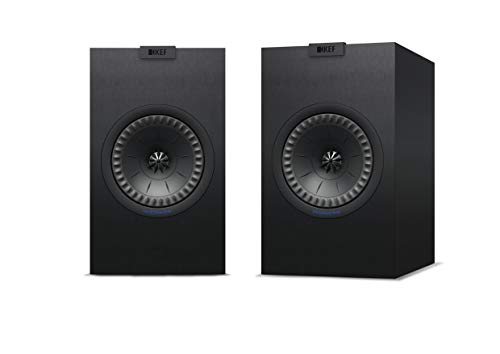
This guide covers three bookshelf speakers whose product pages confirm a coaxial or concentric driver design: two built around KEF’s Uni-Q array and one built around ELAC’s concentric driver. All three are passive bookshelf models sold on Amazon US, and each takes a different route to the same goal: the ELAC is a true three-way, the KEF Q150 is the compact two-way, and the KEF LS50 Meta adds metamaterial absorption behind the tweeter for the cleanest high frequencies of the group.
Disclosure: This article contains affiliate links. If you buy through these links, we may earn a commission at no additional cost to you.
How to Choose Coaxial Bookshelf Speakers for a Small Room
Understand what the coaxial layout buys you
In a conventional speaker, the tweeter and woofer sit at different heights, so their outputs blend correctly only at certain listening angles and distances. Move closer, or stand up, and the balance shifts. A coaxial driver puts both at the same point in space, which keeps the blend stable as you move and makes the speaker behave well on a desk, on stands close to a sofa, or anywhere the seating is near the speakers. In a small room, where nearfield and semi-nearfield listening is the norm rather than the exception, that stability is the main reason to choose this design.
Match the driver count to the room and the amplifier
A two-way coaxial, like the Q150 below, keeps the crossover simple and the cabinet small. A three-way coaxial, like the ELAC UB52, adds a separate woofer so the concentric unit only handles midrange and treble; that usually means cleaner midrange at higher volumes, at the cost of a larger cabinet and a harder load for the amplifier. Check the impedance and sensitivity figures on the product page against your amplifier: the speakers here range from 6 to 8 ohms nominal, and the ELAC’s 85 dB sensitivity asks for an amplifier with some headroom in reserve.
Think about ports and placement before cabinet size
Small rooms often force speakers close to the wall behind them. A rear port pushed against a wall can boom; a front-firing port, like the ELAC’s, is more forgiving of tight placement. KEF’s designs use rear ports with foam bungs supplied in the range’s packaging philosophy, so check what the listing includes. Also consider the cabinet depth: the LS50 Meta is a deep cabinet for its width, and on a shallow shelf or desk that depth, plus room for the port to breathe, decides whether it fits at all.
Set a realistic bass expectation
None of these speakers reaches deep bass; their published responses bottom out in the mid-40 Hz region at best. In a small room that is often an advantage, because room gain lifts the low end and a speaker that tries to play lower usually excites the room’s worst resonances. If your listening is mostly films or electronic music, plan for a subwoofer later rather than choosing a bigger speaker now that the room cannot support.
The 3 Best Coaxial Bookshelf Speakers for Small Listening Rooms
1. ELAC Uni-Fi 2.0 UB52 Bookshelf Speakers
The UB52 is the only true three-way design in this group, and its concentric driver is the reason it qualifies here: a 4-inch aluminum midrange with a 1-inch wide-roll surround tweeter mounted at its centre handles everything above the crossover to the separate 5.25-inch aluminum bass driver. Because the concentric unit never has to reproduce bass, it stays composed at listening levels that would push a two-way’s shared driver harder, which is exactly the behaviour you want when the speakers are two metres away.
The Amazon product page lists the speaker type as Bookshelf, a 6-ohm impedance, a maximum output power of 140 watts, and dimensions that make it the largest cabinet here at 18.3 pounds per speaker. The front-firing port is a practical advantage in small rooms, since the cabinet can sit closer to the wall behind it without the bass thickening as quickly. The page describes the design as an upgrade to the original Uni-Fi series, aimed at a premium two-channel music system or home theatre front channels.
Key specifications from the product page:
- Design: true 3-way, bass reflex, front-firing port
- Concentric driver: 4-inch aluminum midrange with 1-inch tweeter at its centre
- Bass driver: 5.25-inch aluminum cone
- Impedance: 6 ohms
- Maximum power input: 140 watts
- Sensitivity: 85 dB
- Frequency response: 46 Hz to 35 kHz
View the ELAC Uni-Fi 2.0 UB52 on Amazon
Best for: Small rooms where one pair has to handle both music and film front channels, and where the amplifier has enough output for an 85 dB, 6-ohm load.
Watch out for: It is the biggest and heaviest speaker here, and its sensitivity means a small amplifier will run out of headroom sooner than with the KEF models.
2. KEF Q150 Bookshelf Speakers
The Q150 is the compact entry into KEF’s Uni-Q approach: a two-way bookshelf speaker whose 5.25-inch Uni-Q driver array places the 1-inch vented aluminium dome tweeter at the centre of the aluminium midrange and bass cone. The product page describes the array as designed to smooth treble frequencies and deliver a clearer bass response, and the CFD-designed port is intended to reduce the chuffing and midrange leakage that small cabinets can produce.
For a small room, the Q150’s appeal is its footprint and its flexibility. It is the smallest cabinet in this group, it works on stands, on a media unit or either side of a desk, and the Uni-Q dispersion means the sound holds together whether you sit in the centre seat or off to one side. The page lists the model as the Q150B in black, sold as a pair, with an 8-ohm nominal impedance that makes it an easy load for modest amplifiers and AV receivers.
Key specifications from the product page:
- Design: two-way bass reflex bookshelf speaker, sold as a pair
- Driver array: 5.25-inch Uni-Q with 1-inch vented aluminium dome tweeter at its centre
- Port: CFD-designed rear port
- Impedance: 8 ohms
- Model: Q150 (Q150B, black)
Best for: The smallest rooms and desk-adjacent setups, and for listeners who move around rather than sitting in one fixed seat.
Watch out for: The rear port wants some clearance from the wall behind it, and as a two-way it hands both midrange and bass to one cone, so very high levels in a small room will find its limits before the ELAC’s.
3. KEF LS50 Meta Bookshelf Speakers

The LS50 Meta is KEF’s statement version of the same idea. Its 12th-generation Uni-Q driver array pairs a 25 mm vented aluminium dome tweeter with a 130 mm aluminium cone, and behind the tweeter sits the feature that gives the model its name: Metamaterial Absorption Technology, a maze-like structure that absorbs the sound coming off the back of the tweeter instead of letting it reflect inside the cabinet and colour the output. The Amazon page describes the result as a highly precise loudspeaker capable of delivering detailed sound anywhere in the room, which is the small-room use case stated plainly.
The specifications on the page list a bookshelf speaker type, a maximum output power of 100 watts, and dimensions of 302 x 200 x 280.5 mm, so it is a compact but notably deep cabinet. The Carbon Black listing used here is one of several finishes on separate listings; the driver and cabinet are the same across them. In a small room, this is the pick when the listening seat is fixed, the system is built around two-channel music, and you want the point-source imaging of the Q150 taken as far as this format goes.
Key specifications from the product page:
- Design: two-way bass reflex bookshelf speaker, sold as a pair
- Driver array: Uni-Q 12th generation with Metamaterial Absorption Technology
- Tweeter: 25 mm vented aluminium dome
- Midrange and bass: 130 mm aluminium cone
- Maximum output power: 100 watts
- Dimensions: 302 x 200 x 280.5 mm
View the KEF LS50 Meta on Amazon
Best for: Dedicated two-channel listening in a small room with a fixed seat and a capable amplifier.
Watch out for: The deep cabinet needs shelf or stand depth plus port clearance, and the design rewards a good amplifier rather than flattering a weak one.
Comparison Table
| Model | Design | Coaxial driver | Impedance | Port | ASIN |
|---|---|---|---|---|---|
| ELAC Uni-Fi 2.0 UB52 | 3-way bookshelf | 4-inch concentric midrange with 1-inch tweeter, separate 5.25-inch woofer | 6 ohms | Front-firing | B08FF7KBM5 |
| KEF Q150 | 2-way bookshelf | 5.25-inch Uni-Q array | 8 ohms | Rear, CFD design | B071P6KQZX |
| KEF LS50 Meta | 2-way bookshelf | Uni-Q 12th generation with Metamaterial Absorption Technology | 8 ohms | Rear | B08G1T1CYZ |
Frequently Asked Questions
Why do coaxial speakers suit small rooms better than conventional designs?
Because the tweeter and midrange radiate from the same point, the sound stays balanced at short listening distances and across a wider range of seat positions. Small rooms force exactly those conditions: close seating, off-centre chairs and reflective walls nearby. A conventional speaker with separated drivers needs more distance for its outputs to blend, and a small room often cannot give it that distance.
Are these speakers powered, or do I need an amplifier?
All three models here are passive, so each needs an amplifier or AV receiver. Check the impedance and sensitivity figures in the specifications above against your amplifier’s stated output: the ELAC UB52 at 6 ohms and 85 dB sensitivity is the most demanding of the three, while the two KEF models present an 8-ohm load.
Can I use these speakers on a desk?
Yes, with care. The Q150 is the natural desk candidate because of its size. Whichever model you choose, raise the cabinet so the driver array points at ear height, keep the rear port of the KEF models clear of the wall or monitor behind them, and expect to adjust placement in small steps; at desk distances, moving a speaker a few centimetres changes the bass balance noticeably.
Will I still need a subwoofer in a small room?
For most music, no: these speakers reach into the mid-40 Hz region and a small room adds its own low-frequency lift. For film soundtracks and bass-heavy electronic music, a small subwoofer crossed over carefully will add the bottom octave the cabinets cannot reach. Add it after you have placed the speakers, not before, so you know what the room is already contributing.
What is the difference between the Q150 and the LS50 Meta?
Both are two-way KEF bookshelf speakers built around a Uni-Q driver array. The LS50 Meta uses the newer 12th-generation array with Metamaterial Absorption Technology behind the tweeter, a more rigid and deeper cabinet, and a 100-watt maximum output power listing, while the Q150 is the smaller, simpler and easier-to-drive version of the same concept.
Conclusion
For a small listening room, start with the listening distance, not the driver size. If one pair must do everything and your amplifier is up to it, the ELAC UB52’s three-way concentric design is the most complete speaker here. If the room is genuinely small and the budget or amplifier is modest, the KEF Q150 delivers the point-source benefits in the friendliest package. If the system is a dedicated two-channel setup and you want the most refined version of the idea, the LS50 Meta is the step up. In every case, confirm the driver design, impedance and dimensions on the product page before ordering, and leave yourself an evening to fine-tune placement once the speakers are in the room.