Key takeaways
- Compare the best EDC backpacks, from the 5.11 RUSH24 2.0 to the Osprey Daylite Plus, on capacity, laptop fit, MOLLE webbing, and comfort for daily carry.
- Top Pick: 5.11 Tactical RUSH24 2.0 Backpack, Kangaroo
- Runner-up: REEBOW GEAR Military Tactical Backpack 40L, Black
- Also consider: Maxpedition Falcon-II Backpack, Khaki and Foliage Green
The best EDC backpack for most people is the 5.11 Tactical RUSH24 2.0, because it packs 37 liters of organized space, a padded sleeve for a laptop up to 15 inches, MOLLE webbing across the front and sides, and a build that has become the reference point every other everyday carry pack is measured against. If the load is lighter and the look needs to stay low key, the Osprey Daylite Plus is the better choice, a 20 liter commuter that carries a laptop and a day of essentials at roughly half the bulk. For the largest load at the lowest tier, the REEBOW GEAR 40 liter tactical pack and the Condor 3 Day Assault Pack both carry far more than the 5.11 for less, and the Maxpedition Falcon-II sits between them as the compact, heavily built 23 liter option for carriers who want tactical organization in a smaller footprint.
An EDC backpack is not a school bag, a hiking pack, or a travel bag, although it borrows from all three. It is the bag that carries the same kit every day: the laptop, the charger, the notebook, the water bottle, the multitool, the flashlight, the keys, and whatever the day might add. The difference from an ordinary backpack is organization. An EDC pack is divided into pockets that match the kit, with a padded laptop sleeve, a front admin panel for small tools and pens, side pockets that actually hold a bottle, and attachment points for the pouch that does not fit inside.
Capacity is the first number that matters, and it is also the most misunderstood. A liter count tells you how much the bag holds, not how it carries. A 20 liter pack like the Osprey Daylite Plus is the right size for a laptop, a charger, a lunch, and a light layer. A 37 liter pack like the 5.11 RUSH24 2.0 carries a full work kit plus tools and a change of clothes, and it still fits under most desks. A 50 liter pack like the Condor 3 Day Assault Pack is a three day bag, and carrying it half empty every day is worse than carrying a smaller bag that is full.
As an Amazon Associate, we earn from qualifying purchases.
Table of Contents
- Quick Answer
- At a Glance
- What Makes an EDC Backpack Different
- How We Chose These Five
- The Five Backpacks, Reviewed
- 1. 5.11 Tactical RUSH24 2.0 Backpack, Kangaroo
- 2. REEBOW GEAR Military Tactical Backpack 40L, Black
- 3. Osprey Daylite Plus Commuter Backpack, Black
- 4. Maxpedition Falcon-II Backpack, Khaki and Foliage Green
- 5. Condor 3 Day Assault Pack, Olive Drab
- Side-by-Side: The Numbers That Matter
- How to Choose an EDC Backpack
- Packing: Fitting a Full Day Into One Bag
- Care: Keeping an EDC Backpack in Shape
- Safety and Materials Checks
- Who Should Skip EDC Backpacks
- Frequently Asked Questions
- Final Verdict
- Product and ASIN Reference
Quick Answer
Buy the 5.11 Tactical RUSH24 2.0 if you want the standard EDC pack: 37 liters, a padded sleeve for a laptop up to 15 inches, MOLLE webbing for pouches, and a front admin panel that keeps small tools sorted. Choose the REEBOW GEAR 40 liter tactical pack when you want the most capacity at the lowest tier, with a 40 liter main compartment and MOLLE webbing throughout. Pick the Osprey Daylite Plus when the load is light and the look should stay civilian: 20 liters, a laptop sleeve, bottle pockets, and the lightest carry in this guide. Choose the Maxpedition Falcon-II when you want tactical build quality in a compact 23 liter frame, with heavy nylon and a hydration compatible main compartment. Pick the Condor 3 Day Assault Pack when the load runs to multiple days: 50 liters, a 3038 cubic inch main compartment, and the roomiest carry here.
At a Glance
| Backpack | Capacity | Laptop Fit | MOLLE | Weight | Tier |
|---|---|---|---|---|---|
| 5.11 Tactical RUSH24 2.0 | 37 liters | Up to 15 in | Yes | 3.84 lb | Premium |
| REEBOW GEAR Military Tactical 40L | 40 liters | Not stated | Yes | 2.88 lb | Budget |
| Osprey Daylite Plus | 20 liters | Laptop sleeve | No | 1.5 lb | Mid-range |
| Maxpedition Falcon-II | 23 liters | Not stated | Yes | Not stated | Premium |
| Condor 3 Day Assault Pack | 50 liters | Not stated | Yes | 2.5 lb | Budget |
What Makes an EDC Backpack Different
An EDC backpack has four parts that separate it from an ordinary day pack: the laptop protection, the admin organization, the attachment system, and the carry system. A laptop sleeve is the first check, and it is not the same as a laptop pocket. A sleeve is padded on both sides and suspended off the bottom of the bag, so the laptop never takes the impact when the bag is set down hard. The 5.11 RUSH24 2.0 publishes a padded compartment sized for a laptop up to 15 inches, and the Osprey Daylite Plus publishes a dedicated laptop sleeve of the same kind. The other three packs in this guide do not publish a laptop sleeve size, so a buyer who carries a laptop every day should check the fit on arrival and add a padded sleeve if the compartment is unpadded.
The admin panel is the second check, and it is where an EDC pack earns its name. A front pocket with elastic loops, pen slots, card slots, and a zippered mesh pocket turns a jumble of small tools into a kit that can be found by touch. A multitool, a flashlight, a pen, a notebook, and a charging cable each get a loop or a slot, so nothing sinks to the bottom and nothing rattles against the laptop. The 5.11 and Maxpedition packs are built around this idea, with admin panels that open flat and show the whole kit at once. The REEBOW and Condor packs organize more simply, with large front pockets and MOLLE webbing that let the carrier add their own pouches instead.
MOLLE webbing is the third check, and it is the feature that marks a pack as tactical rather than civilian. MOLLE is the grid of stitched webbing loops on the front and sides of a pack, and it lets pouches, holsters, bottle holders, and first aid kits clip on in any arrangement. Four of the five packs in this guide carry MOLLE webbing, and the Osprey is the exception, which is the point: the Osprey is the pack for a carrier who wants no tactical signal at all. MOLLE adds weight and a military look, and it catches on chair backs and car seatbelts, so a buyer should want it for a reason, not as decoration.
The carry system is the fourth check, and it is the part that decides whether a heavy pack is comfortable or punishing. Shoulder straps should be padded, shaped, and adjustable, with a sternum strap that keeps them from sliding off the shoulders. A back panel should be padded and shaped to let air move, because a flat panel against a warm back turns sweaty within an hour. A waist belt helps on a heavy pack, and a compression strap helps on a light one, pulling the load close to the back so it does not swing. The 5.11 and Maxpedition packs are the most developed here, with padded straps and structured back panels built for loads carried all day.
Fabric is the quiet fifth check. Heavy nylon, measured in denier, resists abrasion and holds its shape, and it is what the tactical packs in this guide are made from. The REEBOW listing states a 600 by 600 density fabric, and the Maxpedition is built from heavy 1000 denier nylon. Lighter fabrics save weight and dry faster, and they are the right choice for a commuter pack like the Osprey, which is carried in rain and on trains rather than through brush. Water resistance is not waterproofing: a water resistant fabric sheds a shower, and a pack that will see real rain needs a rain cover or dry bags inside.
How We Chose These Five
We looked for EDC backpacks sold on Amazon, with a real listing and a verifiable product code, covering the three shapes of the category: the tactical MOLLE pack, the civilian commuter pack, and the large multi-day pack. We required a published capacity in liters or cubic inches, because an EDC pack without a stated capacity cannot be compared with anything. We required a real carry system with padded straps, and we excluded fashion backpacks with no internal organization, school bags with no laptop protection, and top loading hiking packs.
We read each listing for the same fields: capacity, dimensions, weight, laptop fit, MOLLE webbing, fabric, and pocket layout. Where a listing did not state a field, we say so rather than filling it in from a similar product, because a guide that invents numbers is worse than a guide that admits a gap. Where two listing records stated the same figure differently, we print both figures and say so.
The Five Backpacks, Reviewed
1. 5.11 Tactical RUSH24 2.0 Backpack, Kangaroo
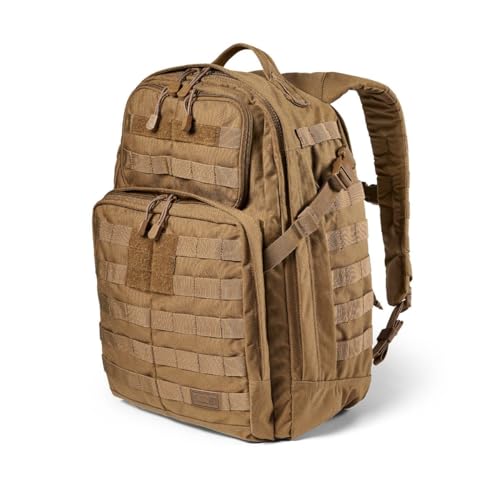
The 5.11 RUSH24 2.0 is the best all-around EDC backpack in this guide, and the reason is that it does every part of the EDC job without a weak side. The capacity is 37 liters, which is the sweet spot for everyday carry: large enough for a laptop, a full tool kit, a water bottle, a jacket, and a lunch, and small enough to slide under a desk or into an overhead bin without a fight. The main compartment measures 20 inches high by 12.5 inches wide by 8 inches deep, and the hydration pocket measures 17 by 12.5 inches, which gives a sense of the flat rectangular shape that makes the pack easy to pack and easy to search. The total capacity is listed as 2275 cubic inches, and the padded laptop compartment fits a laptop up to 15 inches.
The organization is the part that sets the RUSH24 2.0 apart from the budget packs. The front admin panel opens to elastic loops, pen slots, and zippered pockets that hold the small kit in place, and the main compartment is divided so the laptop, the documents, and the bulky gear each have their own space. MOLLE webbing runs across the front and sides, so a pouch, a bottle holder, or a medical kit can be added outside the bag without opening it. The pack also carries a fleece lined eyewear pocket, and the compression straps pull the load tight when the bag is half full so it does not shift on the back.
The carry system is built for a full load carried all day. The shoulder straps are padded and shaped, the back panel is padded and structured, and the listed weight of 3.84 lb is the price of that structure: this is the second heaviest pack in the guide, and the weight is there because the fabric, the padding, and the hardware are all heavier than the civilian packs. A carrier who walks far with a full bag will feel the difference in comfort, and a carrier who drives to a desk will feel it less, so the weight is a trade rather than a flaw. The color in this listing is Kangaroo, a tan brown that reads tactical without shouting.
The RUSH24 2.0 is a second generation design, and the changes from the first version are in the details: a reshaped admin panel, a better laptop compartment, and a cleaner MOLLE layout. For a carrier who wants one bag that covers work, tools, travel, and a go bag without buying three bags, the RUSH24 2.0 is the pick. It is not the lightest pack here, and it is not the cheapest, and it is not the pack for a carrier who wants to disappear into a crowd. It is the pack that does the most, most reliably, for the most kinds of days.
Specs
- Brand: 5.11 Tactical
- Type: Tactical EDC backpack
- Capacity: 37 liters, 2275 cubic inches
- Main compartment: 20 x 12.5 x 8 in
- Hydration pocket: 17 x 12.5 in
- Laptop fit: Padded compartment for a laptop up to 15 in
- MOLLE webbing: Yes, front and sides
- Admin panel: Yes, front, with elastic loops and zippered pockets
- Eyewear pocket: Yes, fleece lined
- Weight: 3.84 lb
- Color: Kangaroo
- Tier: Premium
2. REEBOW GEAR Military Tactical Backpack 40L, Black

The REEBOW GEAR 40 liter tactical pack is the capacity pick at the budget tier, and the reason is simple arithmetic: it holds 40 liters, three more than the 5.11, in a bag that costs less and weighs less. The listed dimensions are 11 by 13 by 20 inches, which is a tall, flat rectangle, and the capacity is stated as 40 liters in the listing record. The fabric is stated as a 600 by 600 density weave, a heavy water resistant nylon. The weight is listed at 2.88 lb in one listing record and 2.85 lb in another, a small disagreement this guide prints rather than smoothing over, because both figures come from the same product family and the difference is a rounding of the same scale.
The layout is simpler than the 5.11, and that is the honest trade for the tier. The main compartment is large and open, with MOLLE webbing throughout the front and sides for attaching pouches, and the front pockets are roomy rather than divided into an admin grid. A carrier who wants the admin panel to sort the small kit will need to add a pouch of their own, and the MOLLE webbing makes that easy, because a small admin pouch clips to the front in seconds. A carrier who packs bulky gear, a change of clothes, or a large medical kit will prefer this layout, because a big open compartment swallows bulky items that a divided admin panel would fight.
The size is the thing to think about before ordering. Forty liters is a three day bag, and carried half empty every day it will flop, sag, and swing on the back. The pack is at its best when it is full: a work kit plus a gym kit, a day of tools plus a jacket and a lunch, or a weekend trip packed into one bag. The black colorway in this listing is the most versatile choice, because it reads as a plain dark bag rather than a military one. The zippers are heavy, the stitching is reinforced at the stress points, and the bag is built to be loaded hard and carried often, which is the right expectation for a budget tactical pack.
For a carrier who needs the most liters for the least money, and who is willing to organize with pouches rather than built-in panels, the REEBOW is the pick. It is not the most refined pack in this guide, and the laptop protection is not stated in the listing record, so a buyer who carries a laptop every day should add a padded sleeve. What it offers is a large, tough, MOLLE covered bag at the budget tier, and no other pick here offers that much room for that little.
Specs
- Brand: REEBOW GEAR
- Type: Military tactical backpack
- Capacity: 40 liters
- Dimensions: 11 x 13 x 20 in
- Material: 600 x 600 density fabric, water resistant
- MOLLE webbing: Yes, throughout
- Laptop fit: Not stated in the listing record
- Weight: 2.88 lb per one listing record, 2.85 lb per another
- Color: Black
- Tier: Budget
3. Osprey Daylite Plus Commuter Backpack, Black
The Osprey Daylite Plus is the pick for a carrier who wants an EDC backpack that does not look like one. At 20 liters it is the smallest pack in this guide, and that is the point: it carries a laptop, a charger, a notebook, a water bottle, and a light layer, and it does it in a slim civilian shape that fits a train seat, an office, and a cafe without drawing a look. The laptop sleeve is dedicated and padded, the water bottle pockets are deep enough to hold a bottle through a commute, and the extra storage pockets keep the small kit sorted without an admin panel that shouts tactical. The listed dimensions are 18 by 10 by 8 inches, and the listed weight is 1.5 lb, the lightest in this guide.
The lightness changes how the pack feels on the back. A 20 liter bag at 1.5 lb empty disappears under a light load, and the padded shoulder straps and ventilated back panel are matched to that load: they are comfortable for a commute and a campus day, and they are not built for a 30 lb tool kit, which the bag is too small to hold anyway. The Daylite Plus is the only pack in this guide with no MOLLE webbing, and that absence is a feature for its buyer, because a civilian pack that clips nothing outside is a pack that catches on nothing and signals nothing.
The capacity limit is real and should be stated plainly. Twenty liters holds a day, not a weekend, and a carrier who adds a gym kit, a heavy tool roll, or a thick jacket will run out of room. The pack is also the least weatherproof of the five in the sense that it has no storm flap over the main zipper, so a hard rain will find its way in without a rain cover or a dry bag inside. Neither limit is a flaw, because the pack was not designed to be a three day bag or a storm bag.
For a commuter, a student, or an office worker who carries a laptop and a light kit every day and wants the bag to vanish into the day, the Daylite Plus is the pick. It is not the pack for a heavy tool load, and it is not the pack for a multi-day trip, and it has no MOLLE for the carrier who wants to build outward. What it offers is the best civilian everyday carry in this guide, from a maker known for fit and a lifetime guarantee.
Specs
- Brand: Osprey
- Type: Commuter EDC backpack
- Capacity: 20 liters
- Dimensions: 18 x 10 x 8 in
- Laptop fit: Dedicated padded laptop sleeve
- Bottle pockets: Yes, dual side pockets
- MOLLE webbing: No
- Weight: 1.5 lb
- Color: Black
- Tier: Mid-range
4. Maxpedition Falcon-II Backpack, Khaki and Foliage Green

The Maxpedition Falcon-II is the compact tactical pick, and it is the pack for a carrier who wants the build quality of the 5.11 in a smaller frame. The capacity is 23 liters, which sits between the Osprey and the 5.11, and the shape is a compact rectangle that works as a day pack, a go bag, and a vehicle bag without taking up a whole seat. The listing describes the pack as a 23 liter tactical backpack, a survival pack, a bug out bag, and a MOLLE go bag for EDC, which is the maker’s own framing, and it is accurate: the Falcon-II was designed to be grabbed and carried, with the essentials already inside.
The fabric is the first thing to notice. The Falcon-II is built from heavy 1000 denier nylon, the heaviest weave in this guide, with reinforced stitching at the stress points and hardware that is sized for hard use. A pack in this fabric does not scuff, sag, or stretch, and it holds its shape empty, which makes it easy to pack and easy to search. The MOLLE webbing covers the front and sides, and the main compartment is hydration compatible, so a water bladder can be carried inside with the hose routed out the top. Dual side pockets hold bottles, and the front pocket is sized for the admin kit.
The trade for the compact size is capacity, and the trade for the heavy fabric is weight, which the listing record reviewed does not state, so this guide does not print a figure rather than borrowing one from another Maxpedition model. Twenty three liters holds a laptop in a sleeve, a tool kit, a water bottle, and a light layer, and it will not hold a change of clothes and a gym kit as well. A carrier who packs heavy should step up to the 5.11 or the REEBOW, and a carrier who packs light will find the Falcon-II carries better than either, because a full small bag rides closer to the back than a half empty large one.
For a carrier who wants a tough, compact, heavily organized EDC pack, and who values build quality over capacity, the Falcon-II is the pick. It is not the cheapest pack here, and it is not the largest, and its laptop fit is not stated in the listing record, so a buyer who carries a laptop every day should check the fit on arrival. What it offers is the most heavily built small pack in this guide, and that durability is the reason to pay the premium tier.
Specs
- Brand: Maxpedition
- Type: Tactical EDC backpack
- Capacity: 23 liters
- Material: 1000 denier nylon
- MOLLE webbing: Yes, front and sides
- Hydration compatible: Yes
- Side pockets: Yes, dual
- Laptop fit: Not stated in the listing record
- Weight: Not stated in the listing record
- Color: Khaki and Foliage Green
- Tier: Premium
5. Condor 3 Day Assault Pack, Olive Drab

The Condor 3 Day Assault Pack is the largest pack in this guide, and it is the pick for a carrier whose everyday carry runs to multiple days. The capacity is 50 liters, listed as 3038 cubic inches, which is more than double the Osprey and a third more than the 5.11. The listed dimensions are 22 by 17 by 11 inches, and the listed weight is 2.5 lb, which is remarkably light for a 50 liter bag, and the lightness comes from a simple layout: a large main compartment, a large front pocket, and MOLLE webbing across the front and sides, with no heavy admin panel and no padded laptop compartment adding structure.
The MOLLE webbing is the organizing system here, and it is extensive. Pouches for medical gear, water bottles, admin tools, and food can be clipped to the front, the sides, and the bottom, so the bag grows outward as the load grows. The main compartment opens wide, which matters in a bag this size, because a top loading sack would bury the gear at the bottom. The Olive Drab colorway in this listing is the classic military green. The fabric is a heavy nylon built for field use, and the zippers and buckles are sized for gloved hands.
The size is the warning as much as the selling point. Fifty liters is a three day bag, and carried half empty on a daily commute it will flop, catch on door frames, and strain the shoulders for no reason. The pack has no stated laptop sleeve, so a buyer who carries a laptop should add a padded sleeve, and the simple shoulder straps are built for a load carried on the back over ground rather than a load carried through a crowded train. This is the pack for a carrier who travels, camps, works outdoors, or keeps a go bag ready, and it is the wrong pack for a carrier who walks to an office with a laptop and a lunch.
For the largest load at the budget tier, the Condor is the pick. It is not the most refined pack here, and it is not the pack for a light daily load, and its laptop protection is not stated in the listing record. What it offers is 50 liters of tough, MOLLE covered space for less than the premium packs, and that room is the whole reason to buy it.
Specs
- Brand: Condor
- Type: Three day assault pack
- Capacity: 50 liters, 3038 cubic inches
- Dimensions: 22 x 17 x 11 in
- MOLLE webbing: Yes, front and sides
- Laptop fit: Not stated in the listing record
- Weight: 2.5 lb
- Color: Olive Drab
- Tier: Budget
Side-by-Side: The Numbers That Matter
| Backpack | Capacity | Dimensions | Laptop Fit | MOLLE | Weight | Tier |
|---|---|---|---|---|---|---|
| 5.11 Tactical RUSH24 2.0 | 37 liters | 20 x 12.5 x 8 in | Up to 15 in | Yes | 3.84 lb | Premium |
| REEBOW GEAR Military Tactical 40L | 40 liters | 11 x 13 x 20 in | Not stated | Yes | 2.88 lb | Budget |
| Osprey Daylite Plus | 20 liters | 18 x 10 x 8 in | Sleeve | No | 1.5 lb | Mid-range |
| Maxpedition Falcon-II | 23 liters | Not stated | Not stated | Yes | Not stated | Premium |
| Condor 3 Day Assault Pack | 50 liters | 22 x 17 x 11 in | Not stated | Yes | 2.5 lb | Budget |
Read the capacity column first, because it is where the five separate most cleanly. The Condor at 50 liters and the REEBOW at 40 liters are multi-day bags, the 5.11 at 37 liters is the large daily bag, the Falcon-II at 23 liters is the compact daily bag, and the Osprey at 20 liters is the light commuter. The weight column is where the trade shows: the 5.11 is the heaviest at 3.84 lb because it carries the most structure, and the Osprey is the lightest at 1.5 lb because it carries the least. The laptop column is the thinnest in this guide. Only the 5.11 and the Osprey publish a laptop fit, so a buyer who carries a laptop every day should check the fit on arrival and add a padded sleeve where the compartment is unpadded.
The MOLLE column is where the tactical packs separate from the civilian one. Four of the five carry MOLLE webbing, and the Osprey is the only pack without it, which is the right split for a guide that covers both buyers. A carrier who wants to build outward with pouches should buy one of the four, and a carrier who wants a clean civilian look should buy the Osprey.
How to Choose an EDC Backpack
Begin with the load, because it decides the capacity. Empty the bag you carry now onto a table, and sort it into three piles: the things you carry every day, the things you carry most days, and the things you carried once. The first pile is the load the new bag must hold, the second pile is the load it should hold, and the third pile belongs in a drawer, not in a bag. Measure the first pile against the capacities in this guide. A laptop, a charger, a notebook, a bottle, and a light layer fit in 20 liters. Add a tool kit, a medical kit, and a jacket, and the load needs 30 to 37 liters. Add a change of clothes and food, and the load needs 40 to 50 liters.
Next, choose the look by the room the bag will enter. A tactical pack with MOLLE webbing reads as a field bag, and it is welcome in a workshop, a job site, and the outdoors, and it is out of place in a client meeting and a formal office. A civilian pack like the Osprey reads as a commuter bag, and it is welcome everywhere, and it gives up the MOLLE attachment system to do it. There is no right answer, only a match between the bag and the rooms it will enter.
Then check the laptop fit, because it is the most expensive thing the bag will carry. A padded sleeve that suspends the laptop off the bottom of the bag is worth more than any other feature, and a bag without one needs a padded sleeve of its own. Measure the laptop, including any case, and compare it with the compartment before ordering, and check the fit on arrival with the laptop inside, the bag closed, and the bag set down firmly on a table. If the laptop moves, the sleeve is too large, and if the zipper strains, the sleeve is too small.
Then check the carry system against the weight you will actually carry. Padded, shaped shoulder straps and a sternum strap are the minimum for any load over a few pounds, and a padded back panel with air channels is the minimum for a load carried for hours. Load the bag with the real kit, walk with it for an hour, and pay attention to the shoulders and the lower back. A bag that digs in at the shoulders needs a sternum strap tightened or a load moved closer to the back, and a bag that pulls backward needs a compression strap tightened or a load moved lower.
Finally, check the zippers, the stitching, and the hardware when the bag arrives. Open and close every zipper five times, and look for a zipper that catches, skips, or separates under a light pull. Look at the stitching where the straps meet the body, because that joint carries the whole load, and look for loose threads or stitching that pulls away from the fabric. Check every buckle and clip for a firm snap. Any of those faults is a reason to return the bag, because a backpack is a load bearing bag and a failure drops everything it carries.
Packing: Fitting a Full Day Into One Bag
Pack an EDC backpack in layers, from the back outward. The laptop goes against the back panel, in the padded sleeve, because it is flat, heavy, and fragile, and the back panel protects it. The documents and the notebook go next, flat against the laptop, because they are flat and light. The bulky gear goes in the middle of the main compartment: the jacket, the lunch, the tool roll, and the medical kit. The small kit goes in the admin panel at the front, where it can be reached without opening the main compartment.
The rule that makes packing work is that everything has a place, and the place never changes. A multitool that lives in the same elastic loop every day can be found in the dark, and a charging cable that lives in the same mesh pocket every day is never left behind. The first week with a new bag is the week to set those places, and the test is simple: pack the bag, close it, walk away, and come back an hour later. If the thing you need is in your hand in ten seconds, the place is right.
Care: Keeping an EDC Backpack in Shape
An EDC backpack needs little care, but the little it needs matters, because a bag that is carried every day picks up dust, rain, and wear faster than a bag that is carried once a month. Empty the bag once a week, shake it out, and wipe the inside with a damp cloth, because crumbs, dust, and grit wear the fabric from the inside and dull the zippers. Brush the outside with a dry brush, and wash off mud with a damp cloth and mild soap, then let the bag air dry away from direct heat. Do not put a backpack in a washing machine and do not put it in a dryer, because the agitation breaks the internal structure and the heat shrinks the fabric and warps the back panel.
Zippers need care of their own. Keep them clean, because grit in a zipper is what makes it catch and separate, and run a zipper open and closed a few times after cleaning to work the grit out. If a zipper sticks, do not force it: work the slider back, clear the fabric or thread caught in the teeth, and try again.
Check the straps and the hardware every month if the bag is carried every day. Look for stitching that has loosened where the straps meet the body, for webbing that has frayed at the edges, and for buckles that no longer snap shut. Any of those is a reason to repair the bag or replace it, because a backpack is a load bearing bag and a failure drops everything it carries. Store the bag empty, with the zippers closed, away from damp, so the hardware does not rust and the fabric does not take a set from being folded.
Safety and Materials Checks
The safety question for a backpack is the strap and buckle question. A backpack carries its load on the shoulders, so a strap that lets go or a buckle that breaks will drop the load without warning, and a heavy load dropped on a stair or a street is a hazard to the carrier and to anyone nearby. Check every strap, buckle, and zipper when the bag arrives and again after a month of wear, and retire a bag whose hardware no longer closes firmly.
The materials question is simpler. The packs in this guide are built from nylon in various deniers, and none of those fabrics is a known skin irritant for most wearers, but a person with a sensitivity to dyes or to fabric finishes should test the straps against the skin for a short wear before a full day.
Recall scoping matters here, because the word backpack appears in several very different product classes that have been recalled, and the word Condor appears in a recall that has nothing to do with this guide. The nearest recalls in the backpack class cover child carriers, not everyday carry packs: in 2016, Osprey recalled its Poco AG child backpack carriers because a cut in the plastic buckle on the shoulder strap could break the buckle and release the strap. Those are carriers that hold a child, not packs that hold a laptop, and none of the five packs in this guide is a child carrier. A separate recall in 2026 covered Ocun Condor HMS Triple locking carabiners, a climbing carabiner whose model name is Condor, made by Ocun, a climbing gear maker. That recall covers a carabiner, not a backpack, and the maker is Ocun, not Condor Outdoor, so it does not touch the Condor 3 Day Assault Pack in this guide. A separate recall covered STIHL backpack blowers, which are powered garden tools worn on the back, not backpacks for carrying gear. No recall was found covering the 5.11 RUSH24 2.0, the REEBOW GEAR tactical pack, the Osprey Daylite Plus, the Maxpedition Falcon-II, or the Condor 3 Day Assault Pack, and no recall was found covering EDC backpacks as a class.
Who Should Skip EDC Backpacks
EDC backpacks are the wrong tool when the load is a laptop and nothing else. A laptop sleeve, a messenger bag, or a slim briefcase carries one laptop better than a backpack, because it is lighter, slimmer, and easier to open on a desk, and a backpack with empty pockets is a bag that flops and swings. If the daily load is only a laptop, a charger, and a notebook, buy a sleeve and skip the backpack entirely.
EDC backpacks are also the wrong tool for a load that belongs on a frame. A multi-day hiking load, a heavy camera kit, or a full set of tools needs a framed hiking pack or a rolling case, because a frameless EDC pack carries weight on the shoulders alone. The Condor at 50 liters is the largest pack here, and it is still a frameless bag, so a carrier who hikes with a full load should buy a hiking pack with a frame and a waist belt that carries the weight on the hips.
Finally, anyone who needs a bag that stays hidden should look elsewhere. A tactical EDC pack with MOLLE webbing is a visible bag, and it signals its contents to everyone in the room. A hidden carry bag that looks like a plain messenger or a slim briefcase is the right tool for a discreet load, and an EDC backpack should stay visible, where its organization is an advantage rather than a signal.
Frequently Asked Questions
What size EDC backpack should I buy?
Buy the capacity your heaviest normal day needs. A 20 liter pack like the Osprey Daylite Plus carries a laptop, a charger, a notebook, a bottle, and a light layer. A 23 to 37 liter pack like the Maxpedition Falcon-II or the 5.11 RUSH24 2.0 adds a tool kit, a medical kit, and a jacket. A 40 to 50 liter pack like the REEBOW or the Condor carries a multi-day load. Measure the load by emptying your current bag onto a table and sorting it into daily, most days, and once only, then buy the capacity the daily pile needs.
Do I need MOLLE webbing on an EDC backpack?
You need MOLLE webbing if you carry a pouch that does not fit inside the bag, such as a medical kit, a water bottle holder, or an admin pouch, and you want it reachable in seconds. You do not need it if the whole kit fits inside, because MOLLE adds weight, catches on furniture, and signals a tactical look. Four of the five packs in this guide carry MOLLE, and the Osprey Daylite Plus is the pack for a carrier who wants none of it.
Can an EDC backpack replace a hiking backpack?
No, not for a real hiking load. An EDC backpack is a frameless rectangular bag built for a daily kit carried for hours, and a hiking backpack is a framed bag built for a heavy load carried for days, with a waist belt that moves the weight to the hips. The Condor is the largest pack here at 50 liters and still frameless, so a carrier who hikes with a full load should buy a framed hiking pack instead.
How do I keep a laptop safe in a backpack without a padded sleeve?
Add a padded laptop sleeve of your own, and pack the laptop against the back panel with the sleeve closed. The sleeve should be padded on both sides and sized to the laptop, so the laptop does not move inside it, and the bag should be set down gently rather than dropped, because a bag without a suspended sleeve passes the impact straight to the laptop. The 5.11 RUSH24 2.0 and the Osprey Daylite Plus publish a padded laptop sleeve, and the other three packs in this guide do not publish one, so a buyer who carries a laptop in those packs should add a sleeve.
Final Verdict
The 5.11 Tactical RUSH24 2.0 is the best all-around EDC backpack in this guide. A 37 liter capacity, a padded sleeve for a laptop up to 15 inches, MOLLE webbing front and sides, and a front admin panel that sorts the small kit make it the pack for work, tools, travel, and a go bag in one bag, and the build quality justifies the premium tier. The REEBOW GEAR 40 liter tactical pack is the pick for the largest load at the lowest tier, because it holds 40 liters of bulky gear in a tough, MOLLE covered bag. The Osprey Daylite Plus is the pick for a light civilian commute, because 20 liters, a padded laptop sleeve, and the lightest carry here make it the bag that disappears into the day. The Maxpedition Falcon-II is the pick for a compact, heavily built tactical pack, because 23 liters of 1000 denier nylon with MOLLE webbing and hydration compatibility is the toughest small bag here. The Condor 3 Day Assault Pack is the pick for a multi-day load, because 50 liters of roomy, MOLLE covered space at the budget tier carries what no other pack here can hold.