Key takeaways
- Compare the best tactical wallets for everyday carry, from machined aluminum frames with multitools to leather and steel builds with RFID blocking.
A tactical wallet is built for people who treat their front pocket like a small tool kit. Instead of soft fabric and a folding bill section, these wallets use machined aluminum, stainless steel, and full-grain leather, often with a multitool, pry edge, or bottle opener built into the frame. The result is a slimmer carry that shrugs off drops, moisture, and daily abuse far better than a traditional bifold.
This guide compares five tactical wallets that take different approaches to the same job. Some lean hard into tools, with removable inserts and hex cutouts. Others keep the rugged materials but stay closer to a classic card holder shape. Every pick below blocks RFID signals, carries cards in a front-pocket footprint, and is made by a brand with a real track record in the everyday carry space.
As an Amazon Associate, we earn from qualifying purchases.
Quick answer
For most people, the Trayvax Contour is the easiest tactical wallet to live with: a stainless steel frame wrapped in leather, with RFID blocking and a shape that still feels like a wallet. If you want tools on board, the Dango M1 Maverick Rail Wallet adds a machined aluminum chassis from a brand known for multitool inserts. The MURADIN Tactical Bifold suits anyone who wants a familiar folding layout, while the Trayvax Ascent and the Hayvenhurst metal wallet cover the steel-frame and plate-style ends of the category.
Dango M1 Maverick Rail Wallet

Dango built its name on wallets that double as tool carriers, and the M1 Maverick Rail Wallet is its all-metal take on that idea. The chassis is machined aluminum in a jet black finish, with a rail-style design that keeps cards stacked in a single rigid frame rather than loose pockets. There are no leather panels on this version, which makes it the most weather-resistant pick in this guide and a good match for outdoor work, range days, and travel in wet climates.
Because the frame is metal on all sides, the wallet blocks RFID signals without any extra lining. Card access follows the plate-wallet pattern: push the stack up from the cutout, fan the cards, and pick the one you need. That motion takes a little practice compared with a bifold, but it keeps the profile flat and even no matter how many cards you load. Dango also sells multitool inserts and bands across its range, so check the listing if you want to add functions later.
Specs
- Material: machined aluminum, all-metal build
- Finish: Jet Black
- Model: DGO-M1-RA-JB
- RFID blocking: yes
- Card capacity: confirm on the listing
- Dimensions and weight: confirm on the listing
Trayvax Contour Wallet
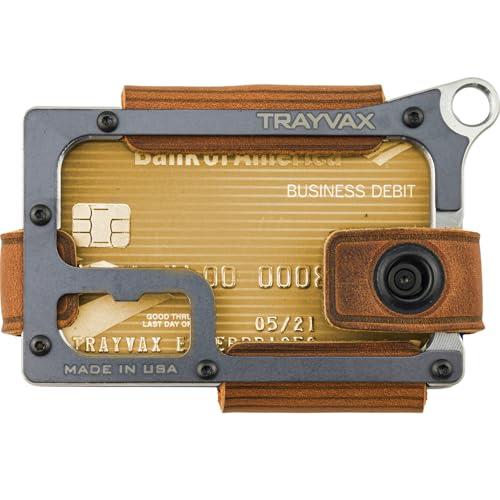
The Contour is the pick that blends in most easily. A stainless steel frame forms the skeleton, and leather wraps the outside, so it reads as a traditional wallet until you look at the hardware. The frame includes a bottle opener cut into the design, and the leather is stitched and riveted to the metal rather than glued, which is the detail that tends to fail first on cheaper hybrids.
RFID blocking is built in, and the layout is a front pocket format with room for cards and folded cash. The steel frame gives the Contour a reassuring heft without turning it into a brick, and the curved profile matches its name: it is shaped to sit comfortably against the leg rather than digging in with square corners. If you like the tactical wallet concept but dress codes or personal taste rule out exposed metal plates, this is the one to start with.
Specs
- Material: stainless steel frame with leather exterior
- Model: CON-004
- RFID blocking: yes
- Extras: integrated bottle opener in the frame
- Card capacity: confirm on the listing
- Dimensions and weight: confirm on the listing
Trayvax Ascent Wallet
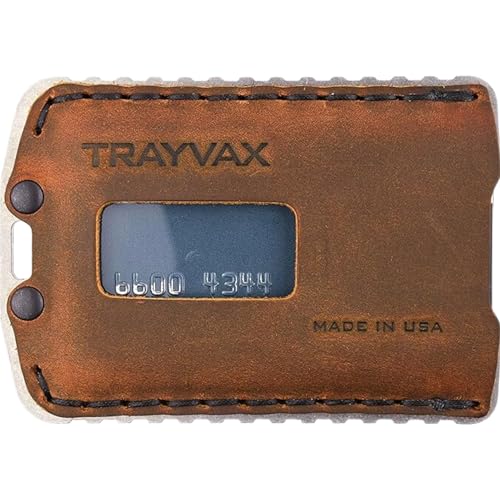
The Ascent takes a simpler route than the Contour. Two leather sides are sewn directly to a stainless steel frame, giving you a wallet that is mostly leather to the touch with metal doing the structural work. A pull tab on one side lifts the card stack for quick access, which is a thoughtful answer to the most common complaint about frame wallets: fishing a single card out of a tight stack.
This is a minimalist layout in the true sense. Cards ride in the frame, cash folds over or tucks behind, and there is no bill section, coin pocket, or ID window. That focus is the point. The Ascent suits carriers who have already cut down to a handful of cards and want a wallet that enforces the habit. The steel frame also provides RFID blocking, and the whole package stays thin enough for any front pocket.
Specs
- Material: stainless steel frame with leather panels
- Model: ANT-001
- RFID blocking: yes
- Card access: pull tab
- Card capacity: confirm on the listing
- Dimensions and weight: confirm on the listing
MURADIN Tactical Bifold Wallet

MURADIN splits the difference between a tactical wallet and a conventional one. The outside is a leather bifold that folds and feels familiar, while an aluminum chassis inside does the heavy lifting: it holds the cards, blocks RFID signals, and gives the wallet its structure. A money clip handles cash, and a carabiner ring on the top corner lets you tether the wallet to a belt loop, bag, or lanyard when you want extra security.
That tether point is a genuinely useful tactical touch for travel, festivals, and job sites, where a wallet that cannot leave your person is worth more than a slightly slimmer one. The bifold layout also means more room than the plate-style picks here, so this is the better choice if your daily carry still includes a few folded bills and a spare key card or two. The trade-off is thickness: folded leather plus a metal core will never be as flat as a bare plate wallet.
Specs
- Material: leather bifold with aluminum chassis
- RFID blocking: yes
- Cash carry: money clip
- Extras: carabiner ring for tethering
- Card capacity: confirm on the listing
- Dimensions and weight: confirm on the listing
Hayvenhurst Metal Wallet with Money Clip

The Hayvenhurst is the straightforward plate wallet of the group. Two aluminum plates sandwich your cards, an elastic band keeps the stack under tension, and a money clip on the outside handles folded bills. The carbon fiber finish gives it the tactical look, while the metal body does the practical work of shielding your cards from RFID skimming.
Listings for this model state a capacity of up to 12 cards, and the footprint is the familiar credit card rectangle, just under 4.3 inches long. There are no tools, tabs, or moving parts to learn: push the cards out from the notch, fan them, and slide them back in. That simplicity, plus the low weight, makes it a sensible first tactical wallet or a backup for a gym bag or glove box. If you regularly carry more than a dozen cards or need receipts and business cards on hand, look at the MURADIN above instead.
Specs
- Material: aluminum
- Finish: Carbon Fiber
- Model: Hv101
- RFID blocking: yes
- Card capacity: up to 12 cards per the listing
- Dimensions: 0.75 x 3.43 x 4.29 inches per the listing
- Cash carry: money clip
How to choose a tactical wallet
Start with the frame material. Machined aluminum is the lightest option and resists water completely, which suits outdoor and work carry. Stainless steel frames weigh more but feel indestructible and are usually paired with leather for a more traditional look. Leather and metal hybrids sit in between: tougher than a plain leather wallet, softer in the pocket than bare plates.
Next, decide how you feel about tools. Integrated multitools, pry bars, and bottle openers are handy, but bladed inserts must be removed before flights, and every cutout adds a small amount of bulk. If your wallet mostly moves between your pocket and a desk, a clean plate or frame design is easier to live with.
Finally, count your real carry. Most tactical wallets are happiest with four to ten cards and a few folded bills. If you carry coins, receipts, or a dozen cards, a bifold hybrid like the MURADIN will serve you better than a minimalist plate, no matter how appealing the slim profile looks.
It is also worth checking the small hardware details before you buy. Elastic bands and silicone straps wear out over time, so brands that sell replacement bands extend the life of the wallet considerably. Likewise, exposed screws and rivets can loosen; a frame you can tighten with a common tool will outlast one that is permanently sealed shut.
Who should skip tactical wallets
Skip this category if you love the soft, broken-in feel of an all-leather bifold; metal frames never soften the same way. Skip it if you carry coins daily, since almost none of these wallets have a coin pocket. Frequent flyers who never check bags may also find tool inserts more trouble than they are worth, because bladed multitools cannot travel in the cabin. And if your cards include several with raised embossing, test the fit early, since rigid frames are less forgiving than fabric pockets.
Frequently asked questions
Do tactical wallets really block RFID signals?
Metal-bodied wallets block RFID signals physically, because the aluminum or steel frame acts as a shield around the cards inside. Leather and metal hybrids rely on the metal chassis or a shielding layer for the same effect. Check the listing for each model, since the exact construction varies.
Can I take a tactical wallet with a multitool on a plane?
The wallet itself is fine in a cabin bag, but any insert with a blade, saw, or knife edge must go in checked luggage or stay home. Many owners remove the tool insert before a trip and reinsert it afterward, which takes a few seconds on designs built for it.
How many cards does a tactical wallet hold?
Most plate and frame designs hold between four and twelve cards comfortably, with folded cash under a band or clip. Bifold hybrids hold more. Embossed cards take up extra room, so count them as roughly one and a half flat cards when you estimate your load.
Will a metal wallet damage my phone screen?
It can if they share a pocket, since machined edges and rivets are harder than glass coatings. Carry the wallet and phone in separate pockets, or choose a leather-wrapped model like the Trayvax Contour, where the outside surface is softer against other gear.
Final verdict
Tactical wallets reward people who carry less but expect more from what they carry. The Trayvax Contour is the most balanced pick here, pairing a steel frame with a leather exterior that works anywhere. The Dango M1 Maverick Rail Wallet is the choice for all-metal durability, the MURADIN Tactical Bifold keeps a familiar folding layout with a tether point, the Trayvax Ascent strips the idea down to its essentials, and the Hayvenhurst delivers the plate-wallet basics in a light, simple package. Match the frame to your routine and any of the five will outlast a conventional wallet.
Product and ASIN Reference
| Product | ASIN |
|---|---|
| Dango M1 Maverick Rail Wallet | B07YWJWK9Z |
| Trayvax Contour Wallet | B072HHFJTN |
| Trayvax Ascent Wallet | B077JFJ7NW |
| MURADIN Tactical Bifold Wallet | B0C3CQZ5C5 |
| Hayvenhurst Metal Wallet with Money Clip | B091JH8P34 |