Our Short List of 3

- Best for: solo measuring across rooms, where standout does the second person’s job.
- Blade length: 25 ft
- Blade width: 1-1/4 in
- Standout: 11 ft
- BladeArmor coating at the hook end, Mylar polyester coating along the blade
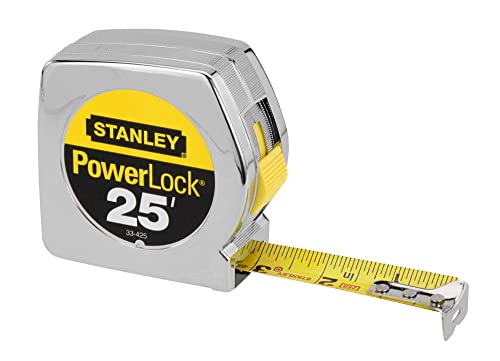
- Best for: a dependable drawer-and-toolbox classic for everyday home measuring.
- Blade length: 25 ft
- Blade width: 1 in
- Standout: 7 ft
- Chrome high-impact ABS case

- Best for: measuring around steel studs, ductwork, and appliances single-handed.
- Blade length: 25 ft
- Magnetic end hook
- Maximum reach: 15 ft
- 5-point reinforced frame
All 5 Picks at a Glance
| Product | Specs | Action |
|---|---|---|
| STANLEY FATMAX Tape Measure, 25-Foot (33-725) |
| Check price on Amazon |
| STANLEY PowerLock Tape Measure, 25-Foot (33-425) |
| Check price on Amazon |
| Milwaukee Compact Wide Blade Magnetic Tape Measure, 25 ft (48-22-0325) |
| Check price on Amazon |
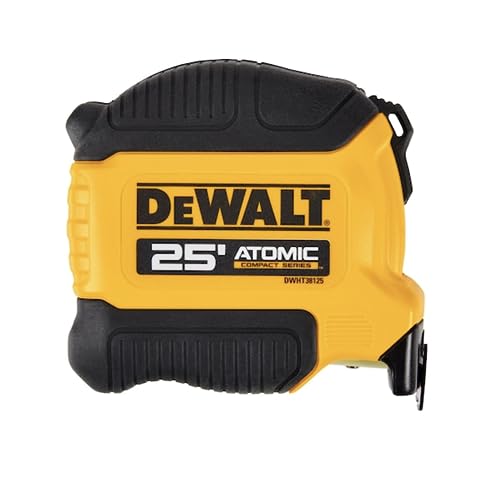 DEWALT Atomic Compact Tape Measure, 25-Foot (DWHT38125S) |
| Check price on Amazon |
 Komelon SL2825IE Self Lock Tape Measure, 25 ft |
| Check price on Amazon |
Key takeaways
- Five 25 ft tape measures for home use compared: wide-blade standout, a chrome classic, a magnetic hook, a compact case and a self-locking budget pick.
Every home ends up needing one tape measure that simply works: long enough for a room, stiff enough to reach across it without a second pair of hands, and readable enough that the number you mark is the number you meant. The confusing part is that nearly every tape on the shelf is 25 feet long, so length alone tells you almost nothing. What actually separates them is blade width, how the lock behaves, the hook at the end, and how the case feels after an hour of use.
This guide is for homeowners, renters, and weekend DIYers who want one dependable tape for furniture, curtains, shelving, and room layouts, plus anyone building a first real toolbox. The five picks below were chosen from their Amazon listing names and stated specifications, and each one wins a different job: standout, classic simplicity, magnetic grip, compact carry, or one-handed ease.
Quick Picks
As an Amazon Associate we earn from qualifying purchases
| Product | Best for | Key spec from title |
|---|---|---|
| STANLEY FATMAX Tape Measure, 25-Foot (33-725) | Solo measuring across whole rooms | 1-1/4 in blade with BladeArmor coating |
| STANLEY PowerLock Tape Measure, 25-Foot (33-425) | A proven classic for the toolbox drawer | Chrome case with Mylar-coated blade |
| Milwaukee Compact Wide Blade Magnetic Tape Measure, 25 ft (48-22-0325) | Steel studs, ducts, and appliances | Magnetic hook with 5-point reinforced frame |
| DEWALT Atomic Compact Tape Measure, 25-Foot (DWHT38125S) | Small hands and all-day belt carry | Compact case with finger brake |
| Komelon SL2825IE Self Lock Tape Measure, 25 ft | One-handed measuring on a budget | Self-locking blade with nylon coating |
How to Choose
Blade Width and Standout
Standout is how far the blade extends before it collapses, and it decides whether you can measure a room alone. Wider blades stand out farther because their curved cross-section is stiffer, which is why the 1-1/4 inch FATMAX blade reaches across spaces that fold a narrow 1 inch blade in half. For ceiling work, long wall spans, and marking both ends of a room by yourself, standout matters more than any other figure on the box. If most of your measuring happens across a workbench or inside cabinets, a shorter standout is fine and usually comes in a smaller, lighter case.
Lock Style and One-Handed Use
A sliding lock asks you to push it with your thumb before the blade can creep, a finger brake lets you meter the retraction with one fingertip, and a self-locking blade holds itself out until you press a button to reel it in. Think about the moment you actually measure: one hand holds the case, the other holds a pencil, and nobody is left to babysit the blade. Locks that engage automatically suit people who measure and mark alone all the time, while a firm manual lock suits careful two-handed work where the reading must not shift at all.
The Hook at the End of the Blade
The loose rivets on a tape hook are not a defect. A Tru-Zero hook slides by exactly its own thickness, so pushing it against a wall and hooking it over an edge both give a true reading, and grabbing one by the hook to check for sloppiness misunderstands the design. Magnetic hooks add a different talent: they latch onto steel studs, ductwork, and appliance panels and hold the end of the blade for you. Choose a magnetic hook if you work around metal framing or large appliances, and a plain hook if your world is wood, drywall, and furniture.
Case Size, Grip, and Carry
A tape you carry all day should disappear on a belt, while a tape that lives in a drawer can afford a bigger, tougher case. Compact cases trade a little grip area for a body that fits smaller hands and shallow pockets, and rubber overmolds earn their bulk when the tape falls off a ladder or a countertop edge. Check where the belt clip sits and whether the case shape lets you hook a finger under the blade comfortably. The best case is the one that matches how the tape will actually travel: belt, pocket, toolbox, or kitchen drawer.
The 5 Best Options
STANLEY FATMAX Tape Measure, 25-Foot (33-725)
- Best for: solo measuring across rooms, where standout does the second person’s job.
- Blade length: 25 ft
- Blade width: 1-1/4 in
- Standout: 11 ft
- BladeArmor coating at the hook end, Mylar polyester coating along the blade
solo measuring across rooms, where standout does the second person’s job.
the wide blade and chunky case feel oversized for small hands and shallow drawers.
If one tape has to cover a whole house, this is the safe default. The 1-1/4 inch blade is the widest here, and that width buys the standout that lets one person measure a room wall to wall without the blade folding halfway. BladeArmor coating guards the first inches near the hook, where tapes wear fastest, and the full blade carries a Mylar polyester coating against abrasion. The case is high-impact ABS wrapped in a rubber overmold, so it shrugs off the drops that crack cheaper housings, and the markings include the 16 inch and 19.2 inch stud centers used in framing layouts.
Watch out for: the wide blade and chunky case feel oversized for small hands and shallow drawers.
STANLEY PowerLock Tape Measure, 25-Foot (33-425)
- Best for: a dependable drawer-and-toolbox classic for everyday home measuring.
- Blade length: 25 ft
- Blade width: 1 in
- Standout: 7 ft
- Chrome high-impact ABS case
a dependable drawer-and-toolbox classic for everyday home measuring.
standout is a modest 7 ft, so long solo spans need a hand supporting the blade midway.
The PowerLock is the tape your grandfather’s toolbox probably held, and it stays in production because the formula works. A 1 inch blade rides in a polished chrome case of high-impact ABS, the blade carries Stanley’s Mylar polyester coating, and the secure lock holds a measurement without creeping while you walk it to the workpiece. The Tru-Zero end hook is riveted at three points and moves by its own thickness, keeping inside and outside measurements honest. There is no standout heroics here and no magnet, just a compact, proven tool that disappears into a drawer and works every time it comes out.
Watch out for: standout is a modest 7 ft, so long solo spans need a hand supporting the blade midway.
Milwaukee Compact Wide Blade Magnetic Tape Measure, 25 ft (48-22-0325)
- Best for: measuring around steel studs, ductwork, and appliances single-handed.
- Blade length: 25 ft
- Magnetic end hook
- Maximum reach: 15 ft
- 5-point reinforced frame
measuring around steel studs, ductwork, and appliances single-handed.
the magnet also collects loose screws and metal filings, so wipe the hook before measuring finished surfaces.
Milwaukee built this tape for people whose measuring happens around metal. The magnetic end hook grabs steel studs, conduit, ductwork, and appliance panels and holds the end of the blade in place while you walk the measurement out alone. The maker rates its reach at 15 ft, the frame is reinforced at five points against drops, and the blade’s nylon coating protects the print on both faces, since the graduations are printed on the front and back of the blade. A finger stop slows retraction without reaching for the lock, and a lanyard loop keeps it attached during overhead work.
Watch out for: the magnet also collects loose screws and metal filings, so wipe the hook before measuring finished surfaces.
DEWALT Atomic Compact Tape Measure, 25-Foot (DWHT38125S)
- Best for: smaller hands and anyone who carries a tape on a belt all day.
- Blade length: 25 ft
- Maximum reach: 13 ft
- Finger brake for controlled retraction
- Removable magnetic end hook
smaller hands and anyone who carries a tape on a belt all day.
the compact case leaves less to grip, and the finger brake takes a few uses to become habit.
The Atomic Compact answers a simple complaint: most 25 ft tapes are bigger than the jobs they measure. DEWALT shrank the case while keeping a full 25 ft blade and a rated reach of 13 ft, so it rides on a belt or in a pocket without the usual brick-like lump. A finger brake under the blade lets you control how fast the tape comes home instead of letting it slam, and the removable magnetic hook sticks to steel when you need a third hand and comes off when you do not. The rubber overmold keeps the small case grippy in dusty or gloved hands.
Watch out for: the compact case leaves less to grip, and the finger brake takes a few uses to become habit.
Komelon SL2825IE Self Lock Tape Measure, 25 ft
- Best for: one-handed measuring and marking, and tight budgets.
- Blade length: 25 ft
- Blade width: 1 in
- Self-locking blade with push-button retraction
- Nylon-coated blade with markings on both edges
one-handed measuring and marking, and tight budgets.
standout is shorter than the wide-blade picks, and there is no metric scale on this model.
The Komelon flips the usual lock logic: the blade locks itself as it extends, and a push button releases it to retract, so measuring and marking alone takes one less thumb movement every single time. The 25 ft blade is nylon-coated, 1 inch wide, and printed with markings along both edges, which makes readings from awkward angles easier to take. Stud centers are marked at 16 inches and 19.2 inches for layout work, and this IE model pairs its inch graduations with an engineer scale. It is the lightest-duty tape here, and also the one many people will enjoy using most.
Watch out for: standout is shorter than the wide-blade picks, and there is no metric scale on this model.
Which One Fits Your Situation
Measuring Rooms Alone for Furniture and Curtains
Room work means long, unsupported spans and nobody at the other end. Reach for the FATMAX first, because its wide blade stands out far enough to cross most rooms, or the Milwaukee if the room involves steel shelving or appliances the magnet can hold. A narrow-blade tape will fold mid-span and turn a two-minute job into a wrestling match, so standout should drive this choice more than case size or lock style.
Working Around Steel Studs, Ducts, and Appliances
Metal changes the job, because the hook can hold itself. The Milwaukee’s magnetic end latches onto studs and ductwork and stays put while you read the far end, and the DEWALT’s removable magnetic hook does the same trick in a smaller case. Keep the magnet wiped clean, since a hook carrying metal filings can scratch finished appliance panels and can read slightly off if debris builds up on its face.
Small Hands, Tight Belts, and Everyday Carry
If the tape travels with you, case size is the spec that matters daily. The DEWALT Atomic Compact carries a full 25 ft blade in the smallest body here, and its finger brake suits the quick pull-measure-release rhythm of carry use. The PowerLock is the other natural carry pick: slim, smooth, and rounded, it slides into a pocket without snagging, and its simplicity means there is nothing extra to break in daily service.
Framing and Stud Layout on a Budget
Layout work lives on the 16 inch and 19.2 inch stud marks, and every pick here prints them. The Komelon is the budget route into that work: its self-locking blade holds each layout line while you mark it, and both edges carry markings for reading from either side of a stud bay. If the framing is steel rather than wood, step up to the Milwaukee and let the magnet hold your starting point.
Common Mistakes
- Choosing by blade length alone, when standout, lock style, and hook type decide how the tape actually behaves in your hands.
- Treating a loose end hook as damage and tightening its rivets, which destroys the Tru-Zero movement that keeps inside and outside readings accurate.
- Letting the blade snap home at full speed every time, which batters the hook rivets and can kink or crack the blade near its end.
- Leaving the blade extended or storing the tape in a damp garage corner, where moisture creeps under the coating and rust starts at the edges.
- Reading the wrong edge of the blade on dual-printed tapes, or trusting a measurement taken with the blade twisted instead of lying flat.
Frequently Asked Questions
Is a 25 ft tape measure long enough for home use?
For nearly every household job, yes. Rooms, furniture, appliances, curtains, and most lumber all fit comfortably inside 25 ft, and the extra blade gives you standout headroom that shorter tapes lack. Longer tapes exist for outdoor and construction spans, but they add case bulk you will feel every day. A 25 ft tape is the size professionals reach for indoors, and it covers a home completely.
What does standout mean, and how much do I need?
Standout is the distance a blade extends before it bends and collapses. It matters whenever you measure alone across open space. Around 7 ft handles bench and cabinet work, while 11 ft or more crosses most rooms without help. Standout is measured on a fresh, flat extension; a worn blade or an overhead angle shortens it in practice, so treat the printed figure as a best case.
Why does the end hook on my tape measure wiggle?
That movement is deliberate. The hook is exactly as thick as the distance it slides, so when you push it against a surface for an inside measurement, or hook it over an edge, the reading stays true in both directions. A hook that has been bent, or one whose rivets were tightened by a well-meaning owner, loses this compensation and gives readings off by the hook’s thickness.
Should I choose a magnetic hook or a plain one?
Choose magnetic if your measuring involves steel studs, metal ductwork, shelving uprights, or large appliances, because the hook holds the end of the blade while you work alone. Choose plain if you mostly measure wood, walls, and furniture, where a magnet only collects stray screws and filings. Neither is more accurate than the other; the Tru-Zero movement that governs accuracy is built into both hook styles.