Key takeaways
- Looking for the best first road bike? Compare beginner-friendly road bikes for fit, gearing, brakes and comfort, then choose one to grow into for years.
The best first road bike is the one that fits you, shifts predictably, stops with confidence, and makes paved-road riding feel inviting rather than intimidating. A first road bike does not need to be the lightest machine in the shop. It needs an upright enough position for a new rider, gears low enough for real hills, brakes that are easy to modulate, and a frame size that matches your height and reach. Get those fundamentals right and the rest of the learning curve becomes far more enjoyable.
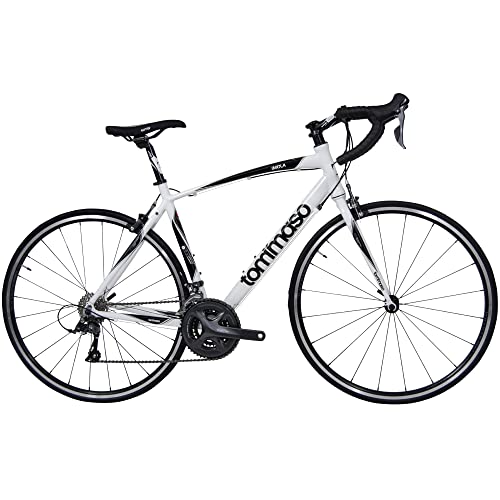

Quick answer: for most new riders, the Tommaso Imola is the strongest starting point because it pairs a full Shimano Claris 24-speed drivetrain with an aluminum frame, a genuine range of frame sizes, and a beginner-friendly position for paved roads. If you want a lighter carbon step-up with disc brakes, the SAVADECK Carbon Disc Road Bike with Shimano Sora is the next rung up. If you want a simpler and more affordable aluminum entry point, the HH Hiland 700C Road Bike is worth a close look. Choose by fit first, then by gearing and brakes, and budget for a helmet, lights, a pump, and a professional check-over after assembly.
Quick Picks
Our Short List of 3
All 3 Picks at a Glance
| Product | Specs | Action |
|---|---|---|
| Tommaso Imola — Best for most first-time road riders | Check price on Amazon | |
| SAVADECK Carbon Disc Road Bike — Best lighter carbon step-up | Check price on Amazon | |
 HH Hiland 700C Road Bike — Best simpler, affordable start | Check price on Amazon |
How to Choose
Start with fit, not with a brand name
Fit decides whether a first road bike feels natural or feels like a wrestling match. A frame that is too large stretches you out, makes steering feel vague, and puts too much weight on your hands. A frame that is too small crowds your knees and leaves you hunched over the bars. Use the maker’s height chart as a starting point, then check standover clearance, reach to the hoods, and saddle height. If you fall between two sizes, the smaller frame is often the safer choice for a beginner, because a shorter stem and a little saddle adjustment can fine-tune it more easily than a frame that is already too long.
Choose relaxed geometry for your first drop-bar bike
Road bikes come in race geometry, endurance geometry, and everything in between. Race geometry puts the bars low and the rider long and low, which is efficient for an experienced rider and tiring for a beginner. Endurance geometry lifts the bars a little, shortens the reach, and keeps the head tube a little taller, which gives a more upright and stable position. For a first road bike, endurance geometry is usually the better choice. It lets you look ahead in traffic, breathe more easily, and ride longer without neck and shoulder fatigue.
Look for a named Shimano drivetrain
The drivetrain is the set of parts that moves the chain and changes gear: shifters, front and rear derailleurs, crankset, cassette, and chain. A named Shimano groupset, such as Claris or Sora, is easier to service, easier to find parts for, and more predictable to shift than an unbranded mix of parts. Claris is the entry point in the Shimano road range, and any bike shop knows it. Sora sits one step above Claris, with a little more refinement in the shift feel. Either one is a sound choice for a beginner.
Make sure the low gears are low enough
New riders often worry about top speed and forget about climbing. On a first road bike, low gears matter far more. A compact crankset with a 50-34 tooth chainring combination, paired with a cassette that reaches to 28 or 32 teeth at the back, gives you a genuine bail-out gear for hills. With that range, you can spin up a climb at a comfortable cadence instead of grinding or walking. A 24-speed triple setup, such as the 3 by 8 arrangement on the Tommaso Imola, gives a wide spread of gears and a very low bottom gear, which is helpful while you are still learning when to shift. An 18-speed 2 by 9 setup, such as Shimano Sora, gives a cleaner and simpler shift pattern with fewer overlapping gears.
Decide between rim brakes and disc brakes
Rim brakes squeeze pads against the wheel rim. They are light, simple, and easy to adjust, and they have served road riders for decades. Disc brakes squeeze a rotor at the hub, and they keep working well in wet weather and on long descents because the braking surface is away from the rim and away from road spray. For a beginner who plans to ride in all weather, or who lives somewhere with long descents, disc brakes are a real advantage. For a beginner who rides mainly in dry weather on flat to rolling roads, rim brakes are perfectly adequate and simpler to maintain.
Check tire clearance and wheel size
Most first road bikes use 700c wheels, which is the standard road size and the easiest size to find tires and tubes for. Tire width matters more than many beginners expect. A 25mm tire is the classic road width and feels quick on smooth tarmac. A 28mm tire gives a little more comfort and grip on rough roads, and it is a sensible choice if your local roads are less than perfect. Check that the frame and fork have room for the tire width you want, and check that the bike comes with a recognized tire brand rather than an unnamed tire that may need replacing early.
Budget for assembly, accessories, and a first service
A road bike bought online arrives partly assembled in a box. The wheels, handlebars, saddle, and pedals need fitting, the gears and brakes need checking, and the bolts need torquing to the correct setting. A professional assembly and safety check protects the warranty on many bikes and catches problems before your first ride. Budget for that service, and for the essentials you cannot ride safely without: a helmet, front and rear lights, a floor pump, a spare tube, tire levers, and a multi-tool.
The Best best first road bike Reviewed
Tommaso Imola — Best for most first-time road riders
The Tommaso Imola has been a familiar answer to the first-road-bike question for years, and the reason is straightforward: it is a proper road bike with a full named drivetrain, a real size range, and a riding position that suits a beginner. The aluminum frame keeps the weight sensible for the class, the 700c wheels roll efficiently on paved roads, and the drop bars give you several hand positions for longer rides. The Amazon listing describes the skill level as Beginner and the intended terrain as paved roads and urban terrain, which matches exactly how most new riders will use it.
The drivetrain is the strongest argument for the Imola. Shimano Claris R2000, in a 24-speed 3 by 8 arrangement, gives you a wide spread of gears and a low bottom gear for hills. Shifting is handled from the drop-bar levers, so you can change gear without moving your hands away from the brakes. The Claris dual pivot brakes are simple rim brakes, easy for a shop to adjust and maintain.
Fit is another reason the Imola works well as a first bike. It is sold in a genuine range of frame sizes, including a small size for riders around five feet six inches to five feet eight inches and a medium size for riders around five feet eight inches to five feet eleven inches, with larger sizes also available. The Imola frame carries a lifetime warranty, with two years on components excluding tires and tubes.
There are trade-offs to understand. Rim brakes are not disc brakes, so wet-weather stopping takes a little more care and a little more lever pressure. The bike arrives requiring assembly, and the maker recommends professional assembly, so plan for a shop visit before your first proper ride.
SAVADECK Carbon Disc Road Bike — Best lighter carbon step-up
The SAVADECK Carbon Disc Road Bike, model R08-R3000-18S, is a different kind of first road bike: a carbon step-up for a beginner who already knows they want to ride regularly and wants a lighter bike with disc brakes from the start. The frame, fork, and seat post are made from Toray T800 carbon fiber, and the listed weight is 9.6 kg, which is light for this class and noticeably lighter than most aluminum bikes at a similar specification.
The drivetrain is Shimano Sora R3000, an 18-speed 2 by 9 system with Sora shift levers, front derailleur, and rear derailleur. The crankset is a 50-34 tooth compact, and the cassette is 11-32 tooth, which gives a low gear that is genuinely useful on hills. Sora sits above Claris in the Shimano road range, and the shift feel is a little more refined. The disc brakes give confident stopping in wet weather and on descents, and the bike is fitted with 700 by 25C Continental tires, which are a recognized brand rather than an unnamed tire.
Partial-fit flag: this is a performance-oriented carbon bike, not a relaxed endurance bike in the classic sense, and it is a step up in ambition as well as in specification. A carbon frame needs a little more care with bolt torque and clamping, and the disc-brake setup needs a little more attention during assembly than a simple rim-brake bike. A beginner who is comfortable with that, or who will have a shop assemble and check the bike, will get a lot from it.
HH Hiland 700C Road Bike — Best simpler, affordable start
The HH Hiland 700C Road Bike is the simplest pick in this guide, and that simplicity is the point. It is an aluminum-framed road bike with 700c wheels, a 14-speed drivetrain, and caliper brakes, aimed squarely at a first-time road rider who wants a real drop-bar bike without a complicated specification.
A 14-speed setup has fewer gears to think about than a 24-speed triple, and for many beginners that is an advantage. You learn the two chainrings, you learn the rear cassette, and you learn when to shift, without worrying about overlapping gear combinations. The aluminum frame is durable and easy to care for, and the caliper brakes are simple to adjust. The bike is presented as a first-time road cycling option, and it is a sensible match for flat to rolling paved roads, fitness rides, and commuting where the route is mostly smooth tarmac.
Partial-fit flag: this is a budget-oriented bike with a simpler drivetrain than the Claris and Sora bikes above, so it is not the pick for a rider who already knows they want a full Shimano road groupset or disc brakes. The gear range is narrower, which means steep hills will feel harder than they would on the Imola or the SAVADECK. If your regular routes include long climbs, choose one of the other two bikes. If your routes are mostly flat, and you want to find out whether road riding is for you before committing to a more advanced bike, the Hiland is a reasonable place to start.
What to Check Before You Buy
Check the frame size against your height and inseam, and confirm the size in the listing before you order. A bike sold in several sizes can have different ASINs for different sizes, so make sure the size you select matches the size chart. Check the wheel size, tire width, and brake type, and confirm that the drivetrain is the named groupset described in the listing rather than a mixed set of parts.
Check the assembly requirement. Most road bikes bought online need professional assembly to validate the warranty and to make sure the gears, brakes, and headset are correctly adjusted. Ask a local shop what the assembly charge covers, and book the check before the bike arrives if you can.
Check your own riding plans honestly. If you will ride mainly on paved roads in dry weather, a rim-brake aluminum bike is a sound choice. If you will ride in rain, on long descents, or on rough roads, disc brakes and a little more tire clearance are worth seeking out.
Finally, check the bike after assembly and before every ride. Squeeze both brakes, check that the wheels are seated and the quick releases are closed, check tire pressure, and check that the handlebars and saddle are tight.
FAQ
What size first road bike should I buy?
Use the maker’s height and inseam chart as a starting point, then check standover clearance and reach to the brake hoods. A bike shop can confirm the size quickly, and that check is worth doing before you commit. If you are between sizes, the smaller frame is often easier to adjust for a beginner, because a shorter stem and a little saddle movement can fine-tune it.
Is a 24-speed bike too complicated for a beginner?
No, a 24-speed triple is not too complicated once you understand the pattern. The three chainrings give a wide range, and the low gears are genuinely useful on hills. The key is to learn the shift pattern in a quiet area first, and to shift before a hill rather than in the middle of it. An 18-speed 2 by 9 setup is simpler, with fewer overlapping gears, and many beginners prefer it.
Are disc brakes necessary on a first road bike?
Disc brakes are helpful, especially in wet weather and on long descents, but they are not necessary for every beginner. Rim brakes are lighter, simpler, and easier to maintain, and they stop well in dry conditions. Choose disc brakes if you will ride in all weather or on hilly routes. Choose rim brakes if you ride mainly in dry weather on flat to rolling roads and want a simpler first bike.
How much assembly does a road bike bought online need?
A boxed road bike usually needs the wheels, handlebars, saddle, and pedals fitted, and the gears, brakes, and headset checked and adjusted. Many makers recommend professional assembly, and it protects the warranty on some bikes. Budget for a shop assembly and safety check, and plan a first service after a few weeks of riding, when cables have stretched and bolts have settled.
Can I use a first road bike for commuting?
Yes, a first road bike can work well for commuting on paved roads, especially if the route is mostly smooth tarmac. Add lights, a lock, and mudguards if the weather demands them, and choose a tire width that copes with your local road surface. If your commute includes unpaved paths, rough roads, or a need to carry a heavy load, a bike with wider tires and disc brakes may be a better match.
Bottom Line
The best first road bike is a bike that fits, shifts cleanly, stops confidently, and invites you to ride again tomorrow. For most beginners, the Tommaso Imola is the best balance of a full Shimano Claris drivetrain, a real size range, and a comfortable position for paved roads. The SAVADECK Carbon Disc Road Bike is the lighter carbon step-up for riders who want Shimano Sora and disc brakes from the start. The HH Hiland 700C Road Bike is the simpler, more affordable entry point for riders who want to learn the basics before committing further.
Disclosure: As an Amazon Associate, we may earn from qualifying purchases.