Our Short List of 3
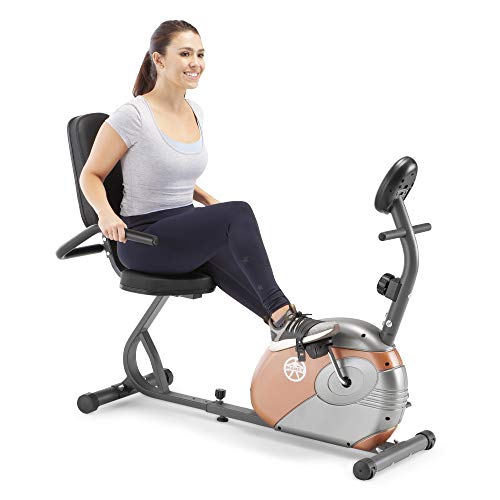
- Strengths: supportive seat and back pad, easy step-through access, quiet magnetic resistance with eight levels, transport wheels
- Limits: larger footprint than an upright, not suited to standing efforts, basic console

- Strengths: folds for storage, 300 lb capacity in listings, eight magnetic levels, pulse display, manageable weight for moving
- Limits: light flywheel feel, limited fit range, not designed for standing sprints

- Strengths: athletic indoor cycling position, 300 lb capacity in listings, four-way seat adjustment, tablet holder, strong resistance range for interval work
- Limits: brake pad and magnetic versions share similar names, narrow saddle will not suit every rider, no back support
All 4 Picks at a Glance
| Product | Specs | Action |
|---|---|---|
| 1. Marcy ME-709 — best cheap recumbent for comfort and easy access |
| Check price on Amazon |
| 2. Exerpeutic Folding Magnetic Upright 1200 — best cheap folding bike for small spaces |
| Check price on Amazon |
| 3. YOSUDA Indoor Cycling Bike — best cheap indoor cycling bike for a more athletic ride |
| Check price on Amazon |
 4. Sunny Health and Fitness Synergy SF-B1879 — best cheap magnetic indoor cycling option |
| Check price on Amazon |
Key takeaways
- Compare the best cheap stationary bike options for home use, including folding, recumbent and indoor cycling models from Marcy, Exerpeutic, YOSUDA and Sunny.
As an Amazon Associate we earn from qualifying purchases.
Affiliate Disclosure: This article contains affiliate links. If you buy through a link on this page, we may earn a commission at no extra cost to you. Product details are taken from manufacturer and retailer listings, and availability should be checked at the time of purchase.
A cheap stationary bike should not mean a flimsy one. At the affordable end of the market, the differences that matter are simple and practical: a stable frame, a resistance system that adjusts smoothly, a seat that can be set to your leg length, a console that shows the basics, and a footprint that fits the room where you will actually ride. Fancy screens, app subscriptions and heavy flywheels can be useful, but they are not what makes a budget bike worth keeping. A basic bike used four times a week will do far more for you than a sophisticated bike that is too large, too noisy or too uncomfortable to ride.
This guide compares four affordable stationary bikes sold on Amazon US, each with a different shape. There is a recumbent for riders who want back support and a low step-through position, a folding upright for small rooms, an indoor cycling bike for riders who want a more athletic riding position, and a magnetic indoor cycling model for smoother, quieter resistance. Cheap is described in qualitative terms here, by what each model leaves out and keeps in, rather than by a promise about what you will pay on the day you shop. Check the exact listing for current availability, included parts and warranty terms.
Quick comparison
| Pick | Type | Resistance | Notable capacity from listings | Best for |
|---|---|---|---|---|
| Marcy ME-709 | Recumbent | Magnetic, 8 levels | Check exact listing | Comfort, back support, easy access |
| Exerpeutic Folding Magnetic Upright 1200 | Folding upright | Magnetic, 8 levels | 300 lb | Small spaces and storage |
| YOSUDA Indoor Cycling Bike | Indoor cycling | Brake pad and magnetic versions in listings | 300 lb | Athletic position and harder sessions |
| Sunny Health and Fitness Synergy SF-B1879 | Indoor cycling | Magnetic, belt drive | 275 lb | Quieter magnetic resistance and a heavier flywheel feel |
What cheap should and should not cost you
A sensible budget bike keeps magnetic or simple friction resistance, manual adjustment, a small battery-powered console and a steel frame. It usually leaves out powered incline, built-in speakers, large touchscreens and automatic resistance control. Those omissions are acceptable for most home riders, because the workout comes from pedalling at the right resistance for the right time, not from the size of the display.
What cheap should not cost you is safety or fit. Avoid any bike whose listing does not state a user weight capacity, whose seat cannot be adjusted to let your knee stay slightly bent at the bottom of the stroke, or whose pedals lack straps to keep your feet secure. Check the assembled dimensions against your room and ceiling, especially for upright and indoor cycling models where you may stand on the pedals. Allow space behind a recumbent for the longer frame and in front of a folding bike for unfolding it safely.
No bike in this guide was tested by us. Specifications are taken from manufacturer and retailer listings. Assembly is required for these models, so keep the manual, tighten fittings after the first few rides, and stop using the bike if the frame, crank or seat post develops movement that the manual does not describe as normal adjustment.
1. Marcy ME-709 — best cheap recumbent for comfort and easy access
- Strengths: supportive seat and back pad, easy step-through access, quiet magnetic resistance with eight levels, transport wheels
- Limits: larger footprint than an upright, not suited to standing efforts, basic console
The Marcy ME-709 is a recumbent exercise bike, which means you sit in a chair-like seat with a back pad and pedal with your legs in front of you rather than underneath you. For riders with back, knee, balance or mobility concerns, that position is often the reason a bike gets used at all. The step-through style frame makes getting on and off easier than swinging a leg over an upright saddle, and the seat adjusts so you can set the distance to the pedals for your leg length.
Resistance is magnetic with eight levels, adjusted manually. Magnetic resistance is a good fit for a recumbent aimed at steady cardio, rehabilitation-style exercise and longer, moderate sessions, because it is smooth and quiet and does not depend on a friction pad wearing against the flywheel. The console is a simple display for the standard workout metrics, and the bike includes transport wheels so it can be tilted and moved for storage or cleaning, which matters because a recumbent frame is longer than an upright.
The ME-709 is built with steel tubing and weighted pedals with straps, according to Marcy listings. The padded seat and backrest are central to its appeal, so riders who find a narrow cycling saddle uncomfortable will usually prefer this shape. The trade-off is intensity and space: a recumbent does not invite out-of-saddle efforts, and it takes more floor length. If your goal is gentle, regular cardio you can sustain while reading or watching a programme, this is the most approachable pick in the guide.
Choose the Marcy if comfort and access come first. Skip it if you want a compact folding bike or a riding position that mimics an outdoor road bike. Confirm the capacity, dimensions and included warranty card on the exact listing before ordering, because this long-running model is sold through several listings and marketplaces.
2. Exerpeutic Folding Magnetic Upright 1200 — best cheap folding bike for small spaces
- Strengths: folds for storage, 300 lb capacity in listings, eight magnetic levels, pulse display, manageable weight for moving
- Limits: light flywheel feel, limited fit range, not designed for standing sprints
The Exerpeutic Folding Magnetic Upright Bike, model 1200, solves the most common home fitness problem: where the bike lives when you are not riding it. The X-frame style design folds to about half its assembled size, has transportation wheels, and weighs about 39 pounds in listings, so one person can move it into a corner or cupboard. Assembled dimensions in listings are about 31 inches long, 19 inches wide and 46 inches high, with a capacity of up to 300 pounds.
Resistance is magnetic with eight tension levels, controlled manually. The large LCD shows distance, calories burned, time, speed, pulse and scan, with hand pulse measurement built into the handlebars. Listings state that the bike adjusts to fit users roughly from 5 feet 3 inches to 6 feet 1 inch, which covers many adults but should be checked if you are outside that range, because a folding upright has less seat adjustment travel than a full-size indoor cycling bike.
The seat is larger than a typical spin bike saddle, which suits the casual and moderate riding this model is built for. It is not a training bike for high-power intervals: the light flywheel, folding frame and upright casual geometry are designed for convenience and steady exercise. Riders who want to stand and sprint, use clipped-in cycling shoes or follow intense studio-style sessions should choose the YOSUDA or Sunny models below instead.
Choose the Exerpeutic if storage space is the deciding factor and your workouts are steady, seated sessions. It is also a sensible choice for a shared room, because magnetic resistance and a belt-style drive keep noise low enough for riding while others watch television in the same space, provided fittings are kept tight.
3. YOSUDA Indoor Cycling Bike — best cheap indoor cycling bike for a more athletic ride
- Strengths: athletic indoor cycling position, 300 lb capacity in listings, four-way seat adjustment, tablet holder, strong resistance range for interval work
- Limits: brake pad and magnetic versions share similar names, narrow saddle will not suit every rider, no back support
The YOSUDA Indoor Cycling Bike is the budget pick for riders who want the position and effort of an indoor cycling class rather than a casual upright ride. Listings describe a heavy-duty steel frame, a flywheel of about 25 pounds in the magnetic version information, a user capacity of 300 pounds, a four-way adjustable padded seat and a two-way adjustable handlebar. That adjustability matters: riders in listings are described as fitting roughly from 4 feet 8 inches to about 6 feet in height, depending on the version, so check the exact version before buying.
YOSUDA listings include both brake pad and magnetic variants under similar names, and that distinction is the most important thing to verify on this model. A brake pad system gives strong resistance and a direct feel, with a press-down stop for the flywheel, but the pad can wear and can be noisier. A magnetic version is quieter and needs less adjustment. Do not assume the cheapest listing you find is the magnetic one; read the resistance mechanism field on the product page and match it to the version you intend to buy.
The bike includes a tablet holder and a small display for ride data in listings, along with cage pedals and transport wheels. The riding position is forward and athletic, the saddle is a cycling saddle rather than a chair, and sessions can be as hard as you make them. That also means new riders should build up gradually, set the seat height so the knee keeps a slight bend at the bottom of the stroke, and keep the handlebar high enough at first to avoid back and wrist strain.
Choose the YOSUDA if you want harder home sessions on a budget frame and you are willing to confirm the exact resistance version. Skip it if you need back support, a step-through frame or a bike that folds away.
4. Sunny Health and Fitness Synergy SF-B1879 — best cheap magnetic indoor cycling option
- Strengths: magnetic resistance with belt drive, 30 lb flywheel in listings, tablet mount, adjustable seat, quiet operation for shared homes
- Limits: 275 lb capacity is lower than rivals here, forward cycling position only, similar Sunny models make exact version checking essential
The Sunny Health and Fitness Synergy, model SF-B1879, is an indoor cycling bike with magnetic resistance and a belt drive, built around a flywheel listed at 30 pounds. That combination is the reason to consider it over a basic friction bike: magnetic resistance avoids pad contact, the belt drive is smoother and quieter than a chain, and the flywheel gives the pedals a steadier momentum feel through the stroke. For an apartment or a house where early morning noise matters, those are practical advantages, not luxuries.
Listings give a user weight capacity of 275 pounds for this model, lower than the YOSUDA and Exerpeutic capacities above, so check that figure against your needs before choosing it. The seat is adjustable, a tablet mount is included, and the riding position is the forward indoor cycling position rather than a recumbent or casual upright posture. Pulse sensors and micro-adjustable magnetic resistance are described in related Sunny listings for this series, but you should confirm the features on the SF-B1879 page itself, because Sunny sells several similar Synergy and Evolution models with different equipment.
Assembly and set-up decide how quiet this kind of bike stays. Level the frame on its stabilisers, tighten the seat and handlebar clamps fully, and recheck them after the first week. A magnetic bike that rocks or has a loose seat post will feel cheap regardless of its drive system.
Choose the Sunny Synergy if quiet magnetic resistance and belt drive are your priorities within a budget indoor cycling bike, and if its stated capacity fits you. Skip it if you need the higher capacity of the YOSUDA, the folding storage of the Exerpeutic or the seated back support of the Marcy.
Upright, recumbent, folding or indoor cycling: which shape fits you?
Choose a recumbent if comfort, back support and easy mounting matter most, and if your workouts are steady and seated. Choose a folding upright if the bike must disappear after use and your sessions are light to moderate. Choose an indoor cycling bike if you want a forward position, higher resistance and harder sessions, and you accept a narrow saddle and no backrest.
Think honestly about the room as well as the workout. A recumbent needs length. An indoor cycling bike needs headroom if you stand. A folding bike needs a storage spot that is genuinely free, not a corner already filled with other equipment. The best cheap bike is the one that fits both your body and your home, because either mismatch ends the habit within a month.
Set-up and maintenance on a budget
Put the bike on a flat, hard surface and consider a mat to protect flooring and reduce vibration. Set the seat first: for upright and indoor cycling bikes, stand beside the saddle and set it near hip height as a starting point, then fine-tune so your knee is slightly bent at the bottom of the stroke. For a recumbent, slide the seat until you can press through the pedal with that same slight bend without rocking your hips.
Keep pedals straps snug, check crank and seat fittings weekly at first, and wipe sweat from the frame and flywheel area after rides. Sweat is corrosive, and budget finishes suffer fastest around the seat post, handlebar clamp and console. For a brake pad model, inspect the pad for wear and glazing. For magnetic and belt models, listen for new noises: a new squeak or knock usually means a loose fitting rather than a failed part, and catching it early keeps a cheap bike feeling solid.
Start with shorter sessions than you think you need. Ten to twenty minutes at a resistance you can hold while breathing steadily is a better beginning than one exhausting ride that leaves you avoiding the bike for a week. Add time before you add resistance, and keep at least one easy day between harder indoor cycling sessions when you are new to them.
Frequently asked questions
Is a cheap stationary bike worth it for weight management and general fitness?
A basic bike can support regular cardio exercise, which is the part that matters for general fitness. Consistency, correct seat height and progressive resistance do more than a large screen or a long feature list. Pair riding with medical advice where you have a health condition, and do not rely on the console calorie figure as an exact measurement.
Magnetic or friction resistance: which is better on a budget bike?
Magnetic resistance is usually quieter, smoother and lower maintenance, because the magnets do not press on the flywheel. Friction or brake pad resistance can feel strong and direct and is common on budget indoor cycling bikes, but the pad wears and may need adjustment or replacement. Choose magnetic for shared rooms and recumbents, and check the exact version on indoor cycling models.
How much space do I need for a stationary bike?
Measure the assembled dimensions on the listing and add working space around it for mounting, especially behind a recumbent and beside an indoor cycling bike. A folding model such as the Exerpeutic 1200 reduces storage space, but it still needs its full assembled footprint while you ride.
What user height and weight limits should I check?
Check both. Every pick in this guide states a capacity in its listings, from 275 pounds for the Sunny Synergy to 300 pounds for the Exerpeutic and YOSUDA models, and height ranges vary by frame. Staying within both limits protects the frame, the seat post and your own comfort.
Verdict
For most budget buyers who want comfort first, the Marcy ME-709 recumbent is the easiest bike to live with and the one most likely to be used daily. For small homes, the Exerpeutic Folding Magnetic Upright 1200 is the clear pick, because it folds away without giving up magnetic resistance or a useful console. For harder, athletic sessions, choose between the YOSUDA for its capacity and adjustability and the Sunny Synergy SF-B1879 for its magnetic belt drive feel, after checking the exact version and capacity on the listing. Measure your room, confirm your height and weight against the stated limits, and pick the shape you will ride on an ordinary weekday, not just on a motivated one.