Key takeaways
- Looking for the best lithium battery for camper van UK use? Compare five 12V 100Ah LiFePO4 leisure batteries for size, cold charging, Bluetooth and BMS.
Choosing the best lithium battery for camper van uk travel comes down to two questions: how much usable power do you need, and how much space do you have to store it? A 12V 100Ah LiFePO4 leisure battery is the most common starting point for a UK camper van, because it holds enough energy for lights, a 12V fridge, a water pump, phone and laptop charging, and a diesel heater fan, while weighing far less than a lead-acid battery of the same nominal capacity. Quick answer: for most UK van conversions, a 12V 100Ah LiFePO4 battery with a 100A battery management system is the right first buy, and a second identical battery in parallel is the simplest way to double capacity later. If you camp in cold weather, choose a model with low-temperature charge protection or a built-in heater, and if your battery bay is tight, choose a compact mini case rather than a full Group 31 case.

A lithium leisure battery is designed to be discharged deeply and recharged from solar, mains, or a DC-to-DC charger while you drive. The five batteries below are all 12V 100Ah LiFePO4 models, each suiting a slightly different van build.
Quick Picks
Our Short List of 3
All 4 Picks at a Glance
| Product | Specs | Action |
|---|---|---|
| LiTime 12V 100Ah Group 24 Bluetooth |
| Check price on Amazon |
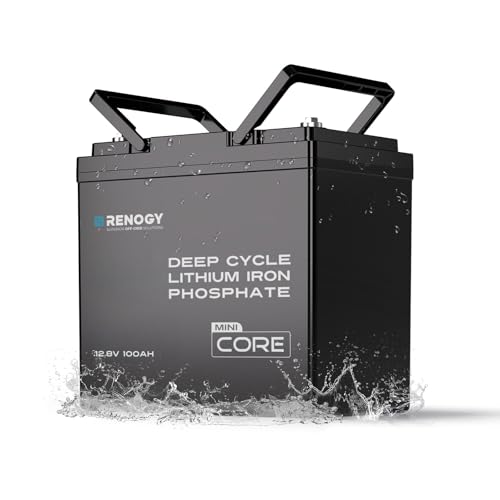
| Renogy Core Mini 12V 100Ah |
| Check price on Amazon |
 LiTime 12V 100Ah Self-Heating Bluetooth |
| Check price on Amazon |
 TCBWORTH 12V 100Ah Mini |
| Check price on Amazon |
How to Choose
Capacity and Usable Energy
A 12V 100Ah battery stores a nominal 1280 watt-hours at 12.8V. A lead-acid battery is normally kept above 50% depth of discharge, so a 100Ah lead-acid battery gives roughly 50Ah of regular usable energy, while a LiFePO4 battery can be discharged far more deeply, which is why one 100Ah lithium battery often replaces a much larger lead-acid bank.
If your daily use is around 40 to 60Ah, one 100Ah battery fits; near 80Ah, add a second in parallel for 200Ah.
Size, Weight and Battery Box Fit
Measure first, then buy. A Group 31 case measures about 13 by 6.8 by 8.4 inches and will not fit every under-seat bay; a Group 24 case is shorter, and a Group 22NF mini case is about 9 by 5.4 inches. Check length, width, height, terminal position, and cable entry, and leave room for cable bends and a monitor shunt.
A 12V 100Ah LiFePO4 battery typically weighs 20 to 31 pounds, far less than a lead-acid equivalent, which helps payload and makes lifting into an under-seat bay easier.
BMS Protection and Discharge Current
Every battery in this guide has a built-in battery management system, usually called a BMS. The BMS protects the cells from overcharge, over-discharge, over-current, short circuits, and high temperature, and it balances the cells during charging. A 100A BMS is standard on a 12V 100Ah battery, and it sets the maximum continuous discharge current at 100A. That is enough for most 12V loads and for a modest inverter, but it is a hard limit.
Check it against your largest load: a 1000W inverter can trip a 100A BMS at full load. Never use a leisure battery as a starter battery unless the maker states it is suitable, as cranking an engine can damage the BMS and cells.
Cold-Weather Charging
Cold weather is the most important UK-specific issue for lithium batteries. LiFePO4 cells can be discharged in the cold, but they should not be charged below freezing without low-temperature charge protection or a built-in heater, as charging cold cells can cause permanent damage. Overnight temperatures in Scotland, Wales, and northern England regularly fall below freezing in winter.
Choose low-temperature charge protection, a self-heating battery, or keep the battery inside the heated living space rather than an unheated locker. Read the charging temperature range in the manual and set your charger to match it.
Bluetooth Monitoring and Wiring
Bluetooth monitoring lets you check voltage, current, state of charge, and temperature from your phone without opening the battery bay, which helps when the battery is under a seat or behind a panel. A battery without Bluetooth can still be monitored with a separate monitor and shunt, and many owners prefer a dedicated wall display.
Use correctly sized cables, a fuse close to the positive terminal, and proper crimped terminals. For parallel pairs, use identical batteries with equal-length cables. If you are not confident with 12V wiring, ask a qualified auto-electrician to check the installation.
Cycle Life, Warranty and Certification
A LiFePO4 battery is commonly listed for 4000 cycles at 100% depth of discharge, with higher counts at shallower levels, and a lifespan of up to 10 years in normal use, against a few hundred cycles at 50% depth of discharge for lead-acid. That is why lithium can be a better long-term choice for a van used often.
Warranties in this guide run 5 to 10 years; check what they cover and whether professional installation is required. Also check UN38.3 transport certification and IP ratings: IP65 means protection against dust and water jets, useful where a battery bay can get damp.
The Best best lithium battery for camper van uk Reviewed
LiTime 12V 100Ah Group 24 Bluetooth
The LiTime 12V 100Ah Group 24 Bluetooth is a strong all-round choice for a UK camper van, because it combines a compact Group 24 case with Bluetooth monitoring and low-temperature charge protection. The Group 24 case is shorter than a Group 31 case, so it fits more under-seat bays and smaller battery lockers, while still holding a full 100Ah. Bluetooth lets you check state of charge, voltage, current, and temperature from your phone, which is useful when the battery is tucked away under a seat or behind a panel.
The battery has a built-in 100A BMS with low-temperature protection, which stops charging when the cells are too cold. The manufacturer lists up to 15000 cycles at a shallower depth of discharge, and 4000 cycles at 100% depth of discharge. It can be connected in parallel with identical batteries, and the IP65 case helps in a damp van.
Note: this model is also listed for trolling motors and marine use, so check the Group 24 fit before you order.
Renogy Core Mini 12V 100Ah
The Renogy Core Mini 12V 100Ah is the compact pick in this guide, and it is the one to look at first if your battery bay is tight. It uses a Group 22NF mini case, measuring about 9.02 inches long, 5.43 inches wide, and 8.39 inches high, and it weighs about 21.8 pounds. That small footprint makes it a good fit for converted panel vans, for under-seat installations, and for vans where two batteries need to share a single bay. Renogy is a well-known name in solar and off-grid equipment, and the Core Mini is designed as a drop-in replacement for a lead-acid battery in many RV and van installations.
The battery has a 100A BMS with low-temperature protection, and it is listed for 5000 cycles at 80% depth of discharge. The IP65 housing can be installed in more than one orientation, which helps in a tight bay, and the 100A continuous discharge covers the surge from a fridge compressor or water pump starting up.
Note: stock for this model has run thin at times, so confirm availability before you commit to a build date.
Battle Born BB10012 100Ah 12V
The Battle Born BB10012 is the brand-of-record battery in this guide, and it is the one to consider if long-term ownership, documentation, and US-based support matter more to you than a compact case. It is assembled in the United States, it carries a 10-year warranty, and it comes with unusually detailed installation documentation, including terminal hardware, torque settings, BMS behaviour, and series and parallel guidance. That documentation is useful in a van build, where a clear manual can save time and help an auto-electrician check the installation.
The battery is a 12V 100Ah LiFePO4 deep-cycle battery with a built-in BMS, 100A continuous discharge, and a 200A surge rating for 30 seconds. It weighs about 31 pounds, and its case measures about 12.76 by 6.86 by 8.95 inches, suiting a Group 27 or Group 31 bay. The standard BB10012 has no Bluetooth and no heater, and it pauses charging in cold weather, so it suits a van where the battery is kept inside the heated living space.
The cycle life is listed at 3000 to 5000 deep-discharge cycles. It is not a starter battery, and it needs a lithium-compatible charger.
LiTime 12V 100Ah Self-Heating Bluetooth
The LiTime 12V 100Ah Self-Heating Bluetooth is the cold-weather pick in this guide. It has a built-in heating system that warms the cells before charging begins, so it can be charged in cold conditions that would stop a standard lithium battery from charging. That makes it useful for UK vans used through the winter, for vans parked in Scotland or in the hills, and for vans where the battery is stored in an unheated locker. It also has Bluetooth 5.0 monitoring, so you can check state of charge, voltage, current, and temperature from your phone, and see when the heater is active.
The battery is a 12V 100Ah LiFePO4 model with a 100A BMS, fitting a universal Group 24 box. It is listed for up to 15000 cycles at a shallower depth of discharge, with low-temperature protection as well as heating, and it can be connected in parallel with identical batteries. Heating uses power from the charger, so it works when a charging source is connected.
Note: this model is also listed for marine use, so confirm the Group 24 fit and charging requirements before you order.
TCBWORTH 12V 100Ah Mini
The TCBWORTH 12V 100Ah Mini is a compact, lightweight first lithium battery for a camper van, and it suits a van where space and weight are tight. It measures about 9.02 inches long, 5.43 inches wide, and 8.19 inches high, and it weighs about 20.7 pounds, which makes it one of the lightest 100Ah batteries in this guide. The mini case fits BCI Group 24, Group 27, Group 31, and Group 49 battery boxes in many installations, but you should still measure your own box, because terminal position and cable clearance vary from van to van.
The battery has a 100A BMS with protection against overcharge, over-discharge, over-current, and short circuits, a 100A continuous discharge, and a 200A peak surge for a few seconds. It is a 12.8V 100Ah LiFePO4 battery with 1280 watt-hours of nominal energy, and the manufacturer states a 5-year after-sales service period.
Note: this model is also listed for trolling motors and solar storage, so confirm the camper-van fit, charging voltage, and BMS limits before you order.
What to Check Before You Buy
Measure your battery box before you order, and write down the length, width, height, terminal position, and cable entry. A battery that is a few millimetres too long will not fit, and a battery with terminals in the wrong place can leave cables stretched or bent. Check the weight as well, because a heavier battery is harder to lift into an under-seat bay, and it uses more of your payload.
Check your charger. A lithium battery needs a charger with a lithium setting, and the charging voltage should match the battery manual, usually around 14.2 to 14.6V for a 12V LiFePO4 battery. A lead-acid charger without a lithium setting can undercharge a lithium battery. If you charge from the alternator while you drive, use a DC-to-DC charger that is suitable for lithium. If you charge from solar panels, use a solar charge controller with a lithium setting and a temperature sensor if one is available.
Check your inverter and your largest load. A 100A BMS limits continuous discharge to 100A, which is enough for most 12V loads, but a large inverter can exceed that limit at full load. Check the wiring, the fuse, and the ventilation too: use cables of the correct size, use a fuse close to the battery positive terminal, and use proper crimped terminals. Keep the battery in a ventilated space, keep it dry, and strap it down so it cannot move while you drive.
Check the warranty and the pack size before you order: some listings show a 2-pack or a 3-pack under a similar title, while each ASIN above is for the single-battery listing described. A 12V lithium leisure battery is a DC battery, so it needs no UK mains plug, but your mains charger, inverter, and hook-up lead do. If you buy from a US listing, check shipping, import rules, and warranty support for UK buyers first.
FAQ
How many lithium batteries do I need for a camper van?
Most UK camper vans start with one 12V 100Ah LiFePO4 battery, which is enough for lights, a 12V fridge, a water pump, a diesel heater, and device charging for a weekend off-grid. If you use an inverter for cooking or for high-power appliances, or if you stay off-grid for several days without driving or solar charging, two 100Ah batteries in parallel give 200Ah and a larger reserve.
Can I replace a lead-acid leisure battery with a lithium battery?
Yes, in most cases a 12V 100Ah LiFePO4 battery is a direct drop-in replacement for a 12V 100Ah lead-acid leisure battery, as long as the case fits the battery box and the terminals match. You will need to change the charger settings to lithium, and you may need a DC-to-DC charger for alternator charging.
Can I charge a lithium camper van battery in winter?
You can charge a lithium battery in winter if it has low-temperature charge protection or a built-in heater, or if the battery is kept warm inside the heated living space of the van. A standard LiFePO4 battery should not be charged below freezing without that protection, because charging cold cells can cause permanent damage.
Do I need Bluetooth on a camper van battery?
Bluetooth is useful, but it is not essential. It lets you check state of charge, voltage, current, and temperature from your phone, which is helpful when the battery is under a seat or behind a panel. A separate battery monitor with a shunt gives the same information on a wall display, and many van owners prefer that approach.
How long will a 100Ah lithium battery last in a camper van?
A 12V 100Ah LiFePO4 battery is commonly listed for 4000 cycles at 100% depth of discharge, with higher cycle counts at shallower discharge levels, and a lifespan of up to 10 years in normal use. How long it lasts in practice depends on how deeply you discharge it, how often you cycle it, how well you charge it, and whether you charge it in cold weather without protection.
Bottom Line
The best lithium battery for camper van uk use is the one that fits your battery box, matches your daily power use, and protects itself in cold weather. For most UK vans, a 12V 100Ah LiFePO4 battery with a 100A BMS is the right starting point. Choose the LiTime Group 24 Bluetooth if you want app monitoring and low-temperature protection in a compact case. Choose the Renogy Core Mini if your battery bay is tight and you want a small, waterproof case from a recognised solar brand. Choose the Battle Born BB10012 if you want a long warranty, detailed documentation, and a proven RV battery. Choose the LiTime Self-Heating Bluetooth if you camp through the winter and you want a battery that can charge on a cold morning. Choose the TCBWORTH Mini if you want a light, compact first lithium battery. Measure first, check your charger, and confirm the pack size and model number before you order.
Disclosure: As an Amazon Associate, we may earn from qualifying purchases.